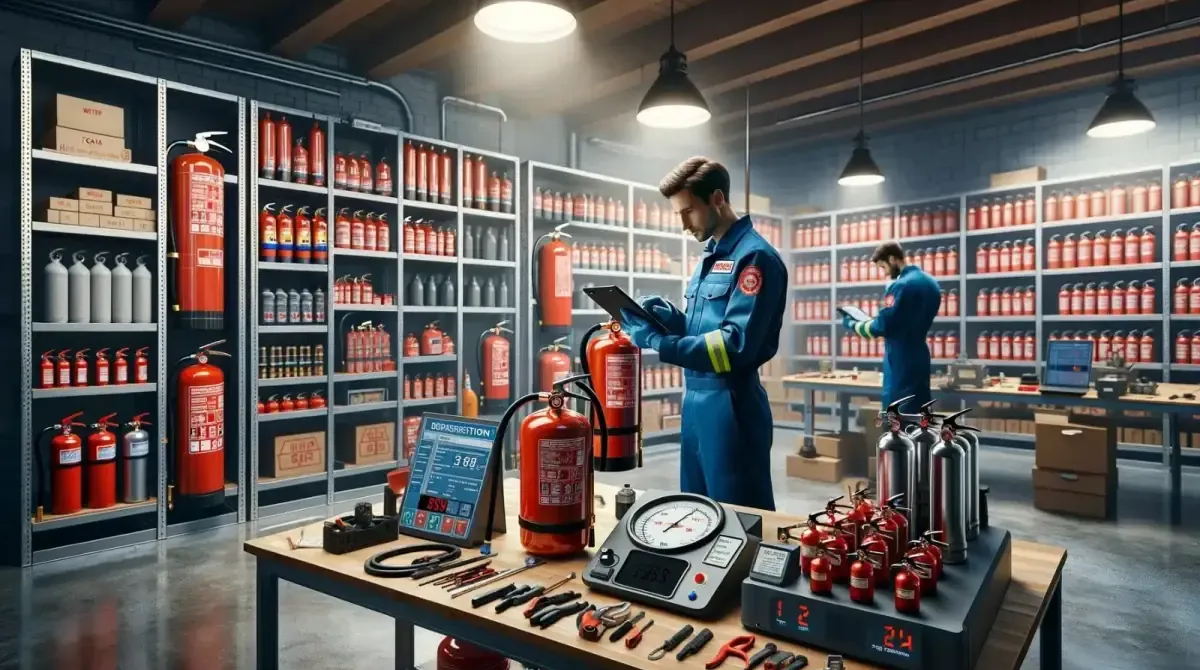
Every portable fire extinguisher in a commercial building runs on four clocks at once: a monthly visual check, an annual maintenance examination, a 6-year internal teardown for most stored-pressure units, and a hydrostatic test every 5 or 12 years depending on the type. Miss any one of them and the unit is out of compliance — and possibly out of commission when someone pulls the pin.
This guide lays out each interval the way NFPA 10 structures it: what gets checked, who is allowed to do the checking, and what record has to exist afterward.
Read this first. NFPA 10 is revised on a multi-year cycle, and the edition your jurisdiction enforces may not be the current one. States and municipalities also adopt local amendments. The intervals and checklist items below reflect commonly cited requirements from recent editions of NFPA 10 as of 2026 — treat them as a working reference, not a substitute for the standard. Always verify the specifics against the edition your Authority Having Jurisdiction (AHJ) enforces and the manufacturer’s service manual for each unit.
The Fire Extinguisher Inspection Checklist at a Glance
| Interval | What happens | Who typically performs it |
|---|---|---|
| Monthly (30-day) | Visual inspection in place — no tools, no teardown | Owner or designated employee; electronic monitoring is permitted in lieu of the manual check under recent editions |
| Annual | Thorough external maintenance examination; new tamper seal; dated service tag | Trained, certified technician |
| Every 6 years | Internal examination for stored-pressure extinguishers on a 12-year hydro cycle; empty, examine, recharge; verification-of-service collar installed | Certified technician |
| Every 5 or 12 years | Hydrostatic test of the shell — interval depends on extinguisher type | Certified technician / qualified test facility |
The rest of this article walks through each row in detail.
Monthly Visual Inspection: The 30-Day Check
NFPA 10 calls for a visual inspection when an extinguisher is first placed in service and at least every 30 days after that. Environments that invite trouble — tampering, corrosion, physical abuse, or frequent obstruction — warrant more frequent checks. This is the one interval that doesn’t require a certified technician: an owner or a designated, instructed employee can do it.
Run this checklist on every unit:
- Location. The extinguisher is in its designated place, matching your placement plan. Units wander — onto job sites, into trucks, behind new shelving.
- Access and visibility. Nothing blocks it. If it’s not in plain sight, signage points to it.
- Pressure. The gauge needle sits in the operable (green) range. Over- or under-pressurized units come out of service.
- Fullness. Lift or weigh the unit to confirm it’s full. A discharged extinguisher can still show a plausible gauge reading.
- Pin and seal. The pull pin is in place and the tamper seal or indicator is unbroken. A broken seal means the unit gets a maintenance examination, not just a new seal.
- Physical condition. No dents, corrosion, or leakage on the shell; hose and nozzle intact and free of obstructions (nests and debris are common in warehouses and exterior cabinets).
- Operating instructions. Legible and facing outward.
- Wheeled units. Check the condition of tires, wheels, carriage, hose, and nozzle.
- Non-rechargeable units. Check the push-to-test pressure indicator where fitted.
Anything that fails gets the unit pulled from service and routed to maintenance, with a spare put in its place.
Document it or it didn’t happen
The monthly check has to leave a record: the inspection date and the inspector’s initials, kept on a tag or label attached to the unit, on a paper checklist, or in an electronic record. Recent editions of NFPA 10 are commonly cited as requiring records of at least the last 12 monthly inspections to be retained. When a fire marshal asks for them, “the tech initials the tag” only works if the tags are actually initialed — and still on the units.
Annual Maintenance: The Certified External Examination
Once a year, every extinguisher needs maintenance — NFPA 10’s term for a thorough examination and any needed repair — performed by a trained, certified technician working to the manufacturer’s service manual. This goes well beyond the monthly glance:
- Examination of mechanical parts: shell, valve assembly, handle, levers, hose, and nozzle
- Verification of the extinguishing agent (condition, quantity by weight where applicable)
- Examination of the expelling means (stored pressure or cartridge)
- Confirmation that the HMIS label and operating instructions are present and legible
- Replacement of the tamper seal on rechargeable units after service
- A new service tag showing the month and year of service, the technician, and the servicing company
Some extinguisher types carry shorter internal-examination intervals on top of this — cartridge-operated units and loaded-stream units are commonly cited as requiring internal examination annually. Check the manufacturer’s manual for each model on your route.
The 6-Year Internal Examination
Stored-pressure extinguishers that sit on a 12-year hydrostatic test cycle — which includes the standard ABC dry chemical unit hanging in most commercial buildings — must be emptied and given a complete internal examination every 6 years, following the procedures in the manufacturer’s service manual.
In practice that means depressurizing the unit, removing the valve assembly, examining the shell interior and components for corrosion and damage, replacing parts as required, recharging, and re-pressurizing. When the work is done, a verification-of-service collar goes around the neck of the cylinder — the collar can only be installed with the valve removed, which is the point: it’s physical proof the unit was actually opened.
The 6-year clock runs from the date of manufacture or the last internal service, and it interleaves with the hydro schedule: a typical dry chemical unit sees internal maintenance at year 6, a hydrostatic test at year 12, internal maintenance again at year 18, and so on.
Hydrostatic Testing: 5-Year and 12-Year Cycles
Hydrostatic testing pressure-tests the integrity of the shell itself. The cylinder is emptied, filled with water or an equivalent fluid, and brought to a specified test pressure to check for leaks, distortion, or failure. It must be performed by certified personnel with the proper equipment — this is not field work.
Intervals depend on the extinguisher type. The table below reflects the intervals most commonly cited from recent editions of NFPA 10 (Table 8.3.1 in current numbering):
| Extinguisher type | Hydrostatic test interval |
|---|---|
| Stored-pressure water, water mist, loaded stream | 5 years |
| AFFF / FFFP foam | 5 years |
| Wet chemical | 5 years |
| Carbon dioxide (CO2) | 5 years |
| Stored-pressure dry chemical | 12 years |
| Cartridge-operated dry chemical / dry powder | 12 years |
| Halogenated agent / clean agent | 12 years |
A shell that fails hydro is condemned — it doesn’t get a second chance. And note the separate rule for non-rechargeable (disposable) extinguishers: they’re typically required to be removed from service no more than 12 years from the date of manufacture, with no hydro option.
Where Inspection Programs Actually Fail
Almost no one fails compliance because they don’t know the gauge should read green. Programs fail on logistics:
- Interval drift. Four overlapping cycles across hundreds of units and dozens of sites, each unit with its own manufacture date. Spreadsheets rot; due dates slip past quietly.
- Records that live on the tag. If the paper tag is the only record and the unit disappears, so does the compliance history.
- Proof on demand. When the AHJ or an insurer asks for twelve months of inspection records across a campus, assembling them by hand takes days.
This is exactly the problem field service software built for inspection work is supposed to solve. In Forz, every extinguisher is a device with a barcode (unique within its system), a location description, and a device type that drives its inspection schedule. A single device can carry multiple inspection types, each with its own due date — a monthly visual and an annual maintenance examination tracked side by side on the same unit — chosen from 14 configurable frequencies that run from daily to every 7 years. Technicians record Pass, Fail, or Bypass with optional photos during the field visit, Forz calculates the next due date from the frequency automatically, and customers can download inspection PDFs themselves from the customer portal instead of calling your office. Pricing is all-inclusive at $50 per user/month on an annual plan — see pricing or book a demo.
FAQ
How often do fire extinguishers need to be inspected?
Under NFPA 10: a visual inspection at least every 30 days, a maintenance examination by a certified technician annually, an internal examination every 6 years for stored-pressure units on a 12-year hydro cycle, and a hydrostatic test every 5 or 12 years depending on type. Harsher environments can require more frequent visual checks.
Who is allowed to perform each level of service?
The monthly visual inspection can be done in-house by an owner or designated employee. Annual maintenance, 6-year internal examinations, and hydrostatic testing must be performed by trained, certified personnel — in most jurisdictions that means a licensed fire protection company. Your AHJ defines exactly what certification it accepts.
What records does NFPA 10 require?
Monthly inspections need a date and initials on a tag, checklist, or electronic record, with the last 12 monthly records retained under recent editions. Annual maintenance requires a service tag showing the month, year, technician, and company. Internal examinations add a verification-of-service collar around the cylinder neck.
When does a fire extinguisher have to be replaced instead of serviced?
When it fails a hydrostatic test (the shell is condemned), when the manufacturer’s parts are no longer available to service it, or — for non-rechargeable units — typically 12 years from the date of manufacture, regardless of apparent condition.
Can electronic monitoring replace the monthly inspection?
Recent editions of NFPA 10 permit electronic monitoring as an alternative to the manual 30-day inspection, provided the system supervises the conditions the manual check would catch. Whether your jurisdiction accepts it depends on the adopted edition and local amendments — confirm with your AHJ before dropping the physical walk-through.
One more time, because it matters: NFPA 10 editions and local amendments vary. Use this checklist to structure your program, then verify every interval and procedure against the edition your AHJ enforces and each manufacturer’s service manual.
Running a fire protection company? Forz helps you schedule recurring inspections, track every device by barcode, and give customers inspection PDFs they can download from the customer portal whenever an AHJ or insurer asks.