If you run an elevator service company, two test categories drive most of your recurring compliance work: the annual Category 1 test and the five-year Category 5 test. Both come from ASME A17.1, the Safety Code for Elevators and Escalators, and both land on your schedule whether the building owner remembers them or not.
The catch is that A17.1 sets the baseline, but your state or city decides which edition applies, who witnesses the test, and where the paperwork goes. Miss those local details and a passing test can still turn into a violation.
Here is how the two categories work, what the Maintenance Control Program requirement adds, and how to keep all of it straight across a few hundred units.
What Are ASME A17.1 Category 1 and Category 5 Tests?
ASME A17.1 (harmonized with Canada’s CSA B44) is the model safety code for elevators, escalators, and related equipment in North America. Section 8.6, which covers maintenance, repair, and testing of equipment already in service, is where the periodic test requirements live.
The industry shorthand sorts those periodic tests into categories by interval:
- Category 1 (Cat 1): performed annually as a “no-load” check of the safety devices and operating systems, generally without test weights.
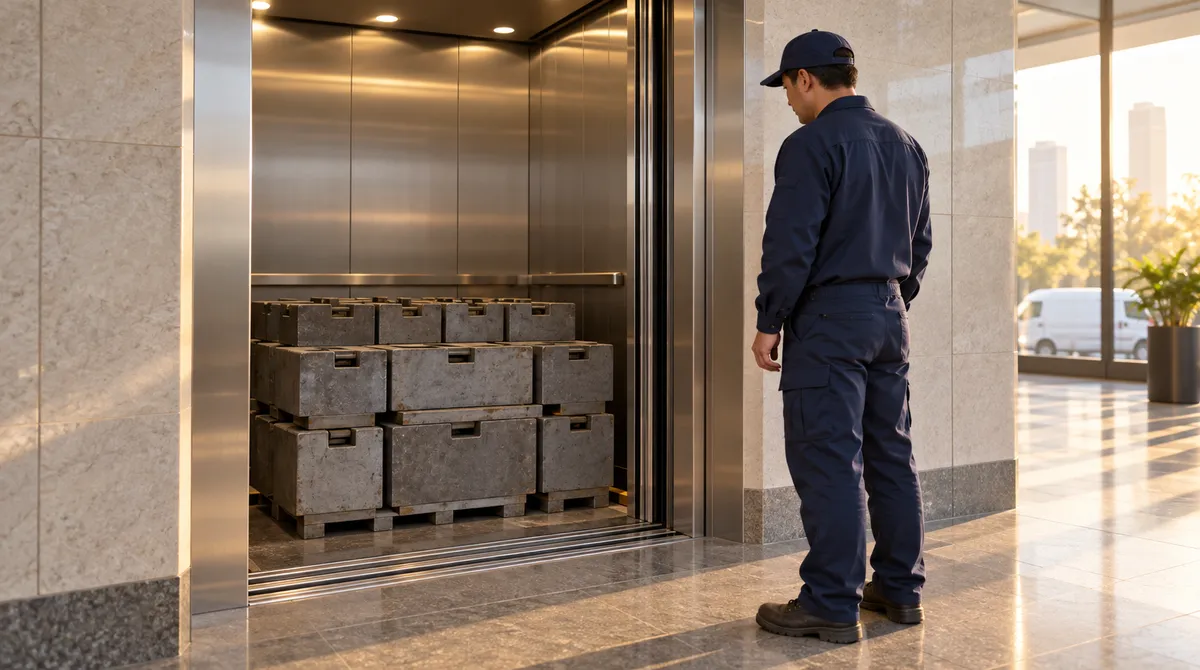
- Category 5 (Cat 5): performed every five years, with rated load in the car. It is the full-load, full-speed proof test of safeties, governors, brakes, and buffers.
A17.1 itself is a model code. It only becomes law when an authority having jurisdiction (AHJ), such as a state elevator bureau or a city buildings department, adopts a specific edition and layers its own administrative rules on top. That is why the test is the same trade-wide but the filing process is not.
Category 1: The Annual No-Load Test
The Cat 1 test is a yearly verification that the elevator’s essential safety components (brakes, door equipment, emergency systems, and related operating devices) function as designed. It is typically described as a no-load test: the safety devices are exercised without placing rated load in the car.
Qualified elevator personnel perform the test. Depending on the jurisdiction, an inspector or third-party witness may need to be present. In some states the mechanic tests and the paperwork stays on site.
A few points operators get burned on:
- Hydraulic elevators carry extra Cat 1 items. Under the 2013 edition, for example, hydraulic units have a relief-valve setting and system pressure test, and older machines with in-ground cylinders or buried piping that cannot be visually inspected may require annual cylinder testing. Wisconsin draws that line at installation contracts dated before January 1, 1994.
- Documentation is part of the test. A17.1 requires test tags (8.11.6) to be completed and displayed on the equipment, and test records kept with the unit’s maintenance records (8.6.1.4.1), though exact subsection numbering varies by edition. An untagged unit reads as an untested unit to an inspector.
- The interval is a real interval. Jurisdictions enforce the annual cycle. New York City, for instance, requires Cat 1 tests each calendar year with at least six months between consecutive tests, per its published rules as of 2026.
Category 5: The Five-Year Full-Load Test
The Cat 5 test is the heavyweight. Every five years, with rated load in the car, the elevator must demonstrate that its safeties, governor, brakes, and buffers will stop a fully loaded car. In practice the Cat 5 visit typically covers the Cat 1 scope as well, plus the load testing.
Key elements reported across jurisdictions:
- Test weights, not assumptions. Car safeties (except those on wood guide rails) and their governors are tested with rated load in the car.
- Brake verification and sealing. For elevators installed under A17.1-2000 and later, the brake setting is verified against the brake marking plate, and the adjustment means is sealed after the test so it cannot be changed without breaking the seal.
- Witnessing. Many AHJs require a Qualified Elevator Inspector (QEI) to observe the test, and NYC requires an unaffiliated third-party witnessing agency.
- Filing. Cat 5 results commonly go to the AHJ, not just the on-site logbook. Wisconsin routes Cat 5 forms to district state inspectors; NYC requires test reports filed within 60 days of the test date, as of 2026.
A Cat 5 is also a disruption event: the car is loaded with thousands of pounds of test weights and run through overspeed and safety scenarios. Buildings need notice, and your crew needs the weights, the time block, and the witness lined up. That is why you want the five-year date visible years out, not weeks.
Category 1 vs Category 5 at a Glance
| Category 1 | Category 5 | |
|---|---|---|
| Frequency | Annually | Every 5 years |
| Load | No load (test weights generally not required) | Rated (full) load in the car |
| Scope | Safety devices and operating systems functional check | Full-load, full-speed proof test of safeties, governor, brakes, buffers (typically includes Cat 1 scope) |
| Performed by | Qualified elevator personnel | Qualified elevator personnel |
| Witnessed by | Varies by AHJ | Often a QEI or third-party witness, per AHJ |
| Records | Test tag on unit + on-site maintenance records; filing varies | Test tag + report typically filed with the AHJ |
One scheduling note: in a year when both tests are due, the Cat 1 obligation does not disappear. Wisconsin’s elevator program, for example, states plainly that Cat 1 tests run at one-year intervals and Cat 5 at five-year intervals with no exception in overlap years. Some individual test items may still satisfy both categories at once.
The Maintenance Control Program (MCP) Requirement
Since the mid-2000s editions, A17.1 Section 8.6 has required a written Maintenance Control Program for each unit. The MCP documents the maintenance tasks, procedures, examinations, and tests for that specific elevator, their frequencies, and the records proving they happened.
Three things contractors should internalize:
- It is per-unit. Four identical traction elevators in the same lobby still need four MCPs, because the program is tied to each unit’s equipment, usage, and environment.
- The owner holds the obligation, you hold the pen. Responsibility for having an MCP in place generally sits with the building owner, but in practice the maintenance contractor creates and maintains it. That makes a complete MCP a selling point and an incomplete one a liability.
- It is the first thing reviewed after an incident. Industry consultants consistently describe a missing or thin MCP as direct evidence to the AHJ, and to plaintiff’s counsel, that required maintenance was not being performed.
Cat 1 and Cat 5 results feed the MCP’s record requirements. If your test documentation lives in a truck cab or a technician’s phone gallery, your customers’ MCPs are incomplete.
Why Requirements Vary by Jurisdiction
Every AHJ adopts its own edition of A17.1 and then adds local administrative rules. Some enforce a recent edition, while others still reference one from a decade ago. The result, as of 2026:
| Variable | Examples of how it differs |
|---|---|
| Code edition | An elevator generally must meet the edition in force where and when it was installed (or last altered) |
| Witnessing | NYC requires an approved agency to test and an unaffiliated third party to witness; other states let licensed personnel test without a witness for Cat 1 |
| Filing | Wisconsin: Cat 5 forms to district inspectors, Cat 1 forms kept on site. NYC: reports filed within 60 days |
| Extra categories | Some jurisdictions also reference Category 3 tests for certain equipment types |
| Equipment carve-outs | Under the 2013 edition, dumbwaiters and material lifts require only Cat 1 testing, not Cat 5 |
Verify with your AHJ. This article summarizes ASME A17.1 testing categories in general terms based on published sources as of 2026. It is not legal or code-compliance advice. Editions, intervals, witnessing rules, forms, and deadlines differ by state and city and change over time. Before you schedule or certify any test, confirm the current requirements with the authority having jurisdiction where the equipment is installed.
Keeping Category Testing on Schedule Across a Portfolio
The code logic is a simple annual plus five-year cycle. The operational problem is scale: hundreds of units across dozens of buildings, each with its own anniversary dates, witness requirements, and paperwork trail.
Forz’s inspection and asset model was built for this problem. Each elevator lives as a device record at its customer site, with its own identity and history. A single unit can carry multiple inspection types with independent due dates (an annual frequency for Cat 1 work and an every-5-years frequency for Cat 5), and Forz calculates the next due date automatically each time a result is recorded. Technicians log pass/fail results with photos from the field on iOS or Android, recurring jobs put the maintenance visits themselves on autopilot, and customers can pull inspection PDFs from their portal whenever an inspector or insurer asks. See how Forz works as elevator service management software.
Every core module is included at $50 per user per month on an annual plan ($60 month-to-month) with a 10-user minimum, plus a free standard data import and onboarding. Book a demo and bring your unit list. Recurring test schedules are usually the first thing we set up.
Frequently Asked Questions
Do Category 1 tests still have to happen in a Category 5 year?
Generally yes. Wisconsin’s elevator program, for example, states that Cat 1 runs at one-year intervals and Cat 5 at five-year intervals with no exception when both fall due, though a few overlapping test items may satisfy both. Confirm how your AHJ handles overlap years.
Who is allowed to perform Cat 1 and Cat 5 tests?
Qualified elevator personnel, typically licensed mechanics employed by an elevator contractor, perform the tests. Witnessing is the variable: many AHJs require a Qualified Elevator Inspector for Cat 5, and NYC requires an unaffiliated third-party witness for category testing.
Is the building owner or the elevator contractor responsible for testing?
Under A17.1 and most local rules, the building owner carries the legal obligation to have the equipment tested and to maintain an MCP. The contractor performs the work. In practice, contractors who track the due dates and drive the schedule keep their customers compliant and keep the contracts.
What is in a Maintenance Control Program?
A written, per-unit program covering the maintenance tasks, procedures, examinations, and tests required by Section 8.6, their frequencies, and records showing they were performed. It must exist for every elevator and escalator, even identical units in the same building.
What happens if a Cat 1 or Cat 5 test is missed?
Consequences vary by jurisdiction but typically include violations and civil penalties, and in some jurisdictions the unit can be removed from service until testing is complete. A documented testing history is also a key defense if an incident ever goes to litigation. Check your AHJ’s enforcement rules for specifics.