Commercial Electrical Panel Safety Inspection Checklist
A safe panelboard inspection works through panel identity and ratings, NEC working-clearance and dedicated-space rules, arc-flash and overcurrent labeling, breaker and connection condition, infrared hot-spot findings, grounding and bonding, and load readings, all performed by a qualified person under an NFPA 70E energized-work risk assessment. This checklist turns a commercial distribution and panelboard safety walkdown, aligned to NFPA 70B electrical maintenance practice, into one record you can complete on site and keep on file for the building owner and your AHJ. Download it as a PDF or Excel file, or run the same items in Forz. Each panel is set up as a device with its own inspection frequency (configurable from daily through every 7 years), technicians record Pass, Fail, or Bypass results with photos in the field on the iOS and Android apps, and customers download the completed inspection PDF from the Customer Portal.
Fill this out on your phone with Forz → Get a free demo · see the mobile apps
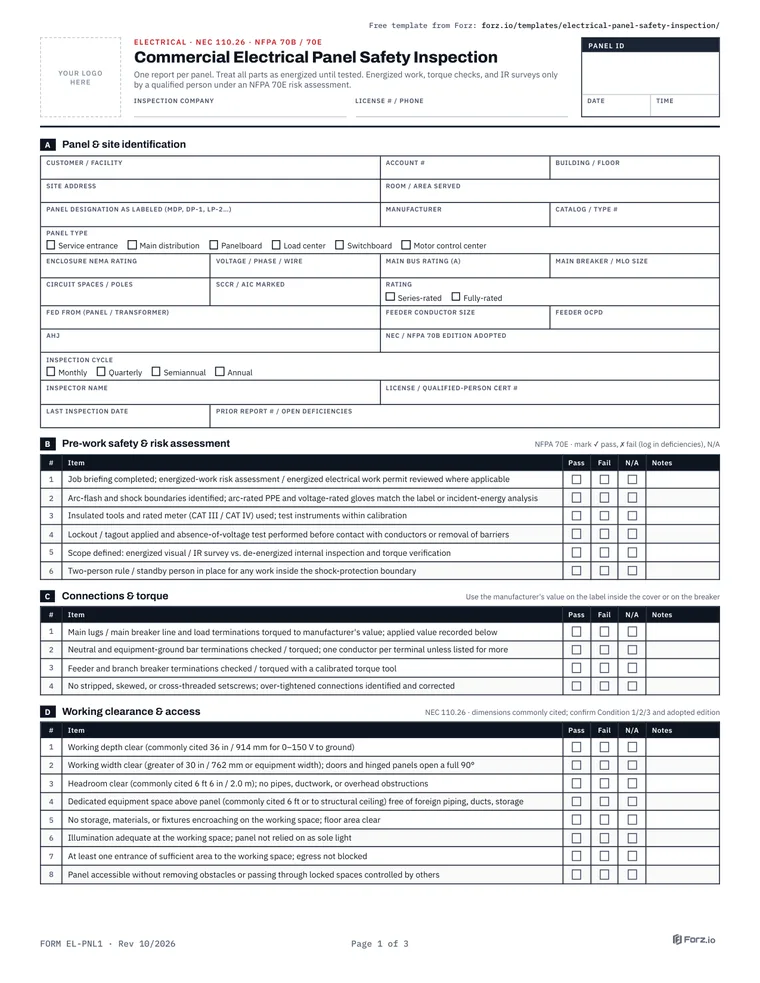
Commercial Electrical Panel Safety Inspection Checklist
Electrical · Checklist
Company: ______________
Date: ______________
Technician: ______________
Panel & Site Identification
- Customer / facility name and account number
- Site address, building, floor, and room or area served
- Panel designation or name as labeled (e.g., MDP, DP-1, LP-2, H1)
- Panel type: service entrance / main distribution / panelboard / load center / switchboard / motor control center
- Manufacturer, catalog or type number, and enclosure NEMA rating
- Voltage and configuration (e.g., 120/208V 3-phase 4-wire, 277/480V 3-phase 4-wire, 120/240V 1-phase 3-wire)
- Main bus ampere rating, main breaker or main lug size, and number of circuit spaces / poles
- Series-rated or fully-rated, and short-circuit current rating (SCCR / AIC) marked on the panel
- Fed from (upstream panel / transformer) and feeder conductor size and overcurrent device
- Inspection date, time, and frequency cycle (monthly / quarterly / semiannual / annual)
- Inspector name, company, and electrical license or qualified-person certification number
- Authority having jurisdiction (AHJ) and NEC / NFPA 70B edition adopted locally
- Date of last inspection and reference to prior report or open deficiencies
Pre-Work Safety & Risk Assessment (NFPA 70E)
- Job briefing completed and energized-work risk assessment / energized electrical work permit reviewed where applicable
- Arc-flash and shock boundaries identified; arc-rated PPE and voltage-rated gloves selected to match the label or incident-energy analysis
- Insulated tools, rated meter (CAT III / CAT IV), and test instruments confirmed within calibration
- Lockout / tagout applied and absence-of-voltage test performed before any contact with conductors or removal of barriers
- Scope of this inspection defined (energized visual/IR survey versus de-energized internal inspection and torque verification)
- Two-person rule / standby person in place for any work inside the shock-protection boundary
- Ambient temperature and panel loading at time of inspection recorded (needed to interpret thermography)
Working Clearance & Access (NEC 110.26)
- Working depth in front of the panel clear, commonly cited as 36 in (914 mm) for systems 0–150V to ground; confirm Condition 1/2/3 and adopted edition
- Working width clear, commonly cited as the greater of 30 in (762 mm) or the width of the equipment, with doors and hinged panels able to open a full 90 degrees; confirm against the adopted edition
- Headroom clear above the working space (commonly cited as 6 ft 6 in, or 2.0 m) and free of pipes, ductwork, and overhead obstructions
- Dedicated equipment space above the panel (commonly cited as 6 ft above the equipment or to the structural ceiling) kept clear of foreign piping, ducts, and storage
- No storage, materials, or fixtures encroaching on the working space; floor area clear and not used for storage
- Illumination present and adequate at the working space; no reliance on the panel as the sole light
- At least one entrance of sufficient area provided to the working space; egress not blocked
- Panel accessible without removing obstacles or passing through locked spaces controlled by others
Labeling, Identification & Arc-Flash Marking
- Field-applied arc-flash hazard label present, legible, dated, and showing nominal voltage plus either incident energy (cal/cm2) and working distance OR the PPE category (not both)
- Arc-flash / shock-hazard warning marking matches the latest study; study revision date recorded and not expired per facility policy
- Equipment marked with available fault current and the date the calculation was performed (where required)
- Service-entrance marking and maximum available fault current label present on service equipment
- Panel directory / circuit schedule complete, legible, and current, with spare and unused circuits identified
- Each overcurrent device clearly and durably identified as to its purpose, with no handwritten ambiguity
- Disconnecting means clearly marked and the load it controls identified
- Required signage present: warning, restricted access, and energized-equipment labels intact and readable
Enclosure, Bus & Breaker Condition
- Enclosure free of corrosion, rust, water intrusion, condensation, and pest entry; rated for the environment
- Deadfront cover and all blank fillers in place; no open knockouts, missing twistouts, or exposed energized parts
- Cover, hinges, latches, and locking provisions intact; door closes and seals properly
- No signs of overheating (discoloration, melted insulation, charring, or a burnt odor) at breakers, bus, or terminals
- Bus bars, breaker stabs, and connections free of pitting, arcing tracks, corrosion, and discoloration
- Circuit breakers seated firmly on the bus, handles operate freely, no cracked cases or broken handles
- Breakers exercised (manually operated off and on) where allowed, or noted as due for exercising per maintenance schedule
- No double-tapped breakers, unlisted breaker/panel combinations, or improper breaker brands used as fillers
- Conductor insulation undamaged, with no nicks, overheating, brittleness, or insulation pulled past the lug
- Wire bending space and gutter fill within limits; conductors neatly dressed and not strained at terminations
- Panel not visibly overcrowded; number of circuits within the panel's listed maximum
Connections, Torque & Thermography
- Main lugs / main breaker line and load terminations torqued to the manufacturer's value (use the label inside the cover or on the breaker) and the applied value recorded
- Neutral bar and equipment-ground bar terminations checked / torqued; one conductor per terminal unless the terminal is listed for more
- Feeder and branch breaker terminations checked / torqued; calibrated torque tool used and last calibration date noted
- No stripped, skewed, or cross-threaded setscrews; over-tightened connections identified and corrected
- Infrared thermography performed under at least ~40 percent rated load with the deadfront removed by a qualified thermographer
- Hot spots logged with location, measured temperature, reference temperature, and delta T (component-to-component or component-to-ambient)
- Severity classified per commonly cited NETA guidance: 1–3C investigate/trend, 4–15C repair as scheduling permits, 16–40C repair soon, over 40C above ambient immediate/imminent failure
- Each hot connection traced to lug, stab, breaker, splice, or bus and tagged for corrective action with priority
- Load balancing reviewed where a phase shows abnormal heating attributable to imbalance rather than a loose connection
Grounding, Bonding & Protective Devices
- Main bonding jumper present and intact at the service; neutral-to-ground bond made at the service disconnect only
- Subpanels verified with an isolated (floating) neutral bar, no neutral-to-ground bond, and no shared neutral/ground terminations downstream
- Grounding electrode conductor and equipment grounding conductors landed, sized, and free of corrosion or looseness
- Equipment ground / bonding continuity to the enclosure and metallic raceway confirmed; bonding bushings present where required
- GFCI protection tested with the test button (and tester where applicable); device trips and resets correctly (record results)
- AFCI protection tested with the test button; device trips and resets correctly (record results)
- Surge protective device (SPD), where installed, shows normal status indicator and connections sound
- Ground resistance / continuity reading recorded where the scope includes testing the grounding electrode system
Load Readings & Measurements
- Line-to-line and line-to-neutral voltages on each phase recorded; within nominal tolerance and balanced
- Per-phase current (amps) measured at the main and recorded; calculated demand within the bus and main breaker rating
- Phase imbalance evaluated; neutral current measured and abnormal harmonic neutral loading noted
- Continuous loads checked against the commonly cited 80 percent limit for the overcurrent device rating; oversized or undersized OCPD for the conductor flagged
- Frequency / power-quality observations noted where instrumentation is available (voltage sag, flicker, harmonics)
- Infrared baseline readings recorded for trending against prior and future inspections
- Ambient temperature, load percentage, and emissivity setting recorded with the thermal data for repeatability
Results, Deficiencies & Sign-Off
- Overall result: pass / deficiencies noted / critical safety hazard / equipment removed from service
- Each deficiency described with panel ID, circuit/location, severity, and NEC / NFPA reference where known
- Immediate hazards (exposed energized parts, blocked clearance, failed bond, imminent-failure hot spot) flagged and the owner notified at once
- Corrective action recommended with priority and a work order, proposal, or quote reference
- Photos, thermal images, and measurements attached (count and reference numbers)
- Owner or representative notified of deficiencies (name, contact, and date)
- Next inspection due date and any interim re-scan dates for monitored hot spots
- Inspector printed name, signature, license / certification number, and date
- Owner / authorized representative printed name, signature, and date
Technician signature
Customer / owner signature
Items above are summarized from publicly available NEC, NFPA 70B (electrical maintenance), and NFPA 70E (electrical safety) guidance and NETA thermography practice current as of 2026; clearance dimensions, label content, fault-current marking thresholds, torque values, and thermography severity bands are edition-, manufacturer-, and condition-dependent. Editions and locally adopted amendments vary; verify the scope and frequencies against your AHJ and the adopted edition, and confirm working-clearance conditions, arc-flash study results, and manufacturer torque specifications for the specific equipment. Electrical panel work exposes personnel to shock and arc-flash hazards: de-energize and lock out wherever possible, treat all parts as energized until tested, and perform energized inspection, torque verification, and infrared surveys only under an NFPA 70E risk assessment using a qualified person with the correct rated PPE and tools. This template is a starting point for your inspection records. It is not the standard, and it does not replace inspection, testing, and maintenance by qualified personnel.
Stop filling out paper forms
This same checklist runs in the Forz mobile app, where you also get photo documentation, digital signatures, automatic certificates, and recurring schedules so the next one books itself.
See how digital inspections work →Run inspections without the paperwork
Forz turns checklists like this one into mobile workflows. Techs complete them in the field with photos, and Forz files them automatically.