Field Service Inspection Report
A consistent inspection report is the difference between a technician's memory and a record you can defend to the customer, your insurer, and whoever inherits the account next year. This trade-agnostic template captures the asset's identity and nameplate, the environmental conditions during the visit, a component-by-component assessment on a 1-to-5 condition scale, every deficiency with severity, priority, and photo references, the recommended corrective action, and the next service due date, all closed out with dual signatures. Download it as a PDF or Excel file for any asset class, or run the same report digitally in Forz, where technicians record Pass, Fail, or Bypass results with photos on iOS and Android, set the next due date from the inspection frequency, and customers download the inspection PDF from their portal.
Fill this out on your phone with Forz → Get a free demo · see the mobile apps
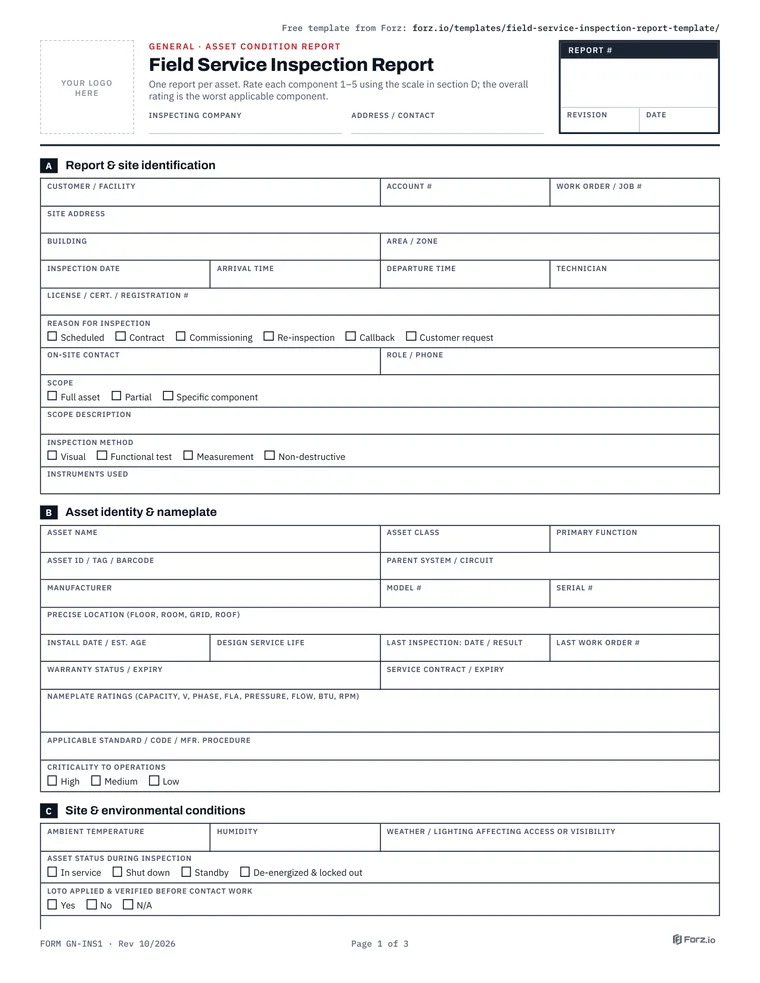
Field Service Inspection Report
General · Report
Company: ______________
Date: ______________
Technician: ______________
Report & Site Identification
- Report number and revision (if reissued)
- Customer or facility name and account number
- Site address, building, and specific area or zone
- Work order or job number this inspection is billed to
- Inspection date and time on site (arrival and departure)
- Reason for inspection: scheduled / contract / commissioning / re-inspection / callback / customer request
- Scope of inspection: full asset / partial / specific component (describe)
- Inspecting company name, address, and contact
- Technician name and license, certification, or registration number
- Inspection method: visual / functional test / measurement / non-destructive (note instruments used)
- On-site contact name, role, and phone number
Asset Identity & Nameplate
- Asset name, class, and primary function
- Asset ID, tag, or barcode and parent system or circuit it belongs to
- Manufacturer, model number, and serial number
- Precise location (floor, room, grid, roof, or mechanical space)
- Installation date or estimated age and design service life
- Date and result of last inspection, and last work order reference
- Warranty status and service-contract coverage with expiry
- Nameplate ratings recorded (capacity, voltage, phase, full-load amps, pressure, flow, BTU, or RPM as applicable)
- Applicable standard, code, or manufacturer procedure this inspection follows
- Asset criticality to operations: high / medium / low
Site & Environmental Conditions
- Ambient temperature and humidity at time of inspection
- Weather and lighting conditions affecting access or visibility
- Asset status during inspection: in service / shut down / standby / de-energized and locked out
- Lockout/tagout applied and verified before contact work: yes / no / N/A
- Required PPE worn and confined-space or hot-work permit in effect: yes / no / N/A
- Housekeeping and cleanliness around the asset: clear / cluttered / contaminated
- Required working clearance, egress, and service access maintained per code
- Conditions or access limitations that prevented full inspection (note components not assessed)
Condition Rating Scale (Apply Per Component)
- 1 = Very good: as-new, no defects, no action required
- 2 = Good: minor cosmetic wear, fully serviceable, monitor at next visit
- 3 = Fair: functional but showing wear or minor defects; plan corrective action
- 4 = Poor: significant deterioration or reduced function; corrective action required soon
- 5 = Unserviceable: failed, unsafe, or non-compliant; remove from service or repair immediately
- N/A = Component not present, not accessible, or outside the agreed scope
- Overall asset condition rating (1-5) assigned from the worst applicable component
- Asset operating correctly at time of inspection: yes / no / intermittent
Component-by-Component Inspection
- Structure, housing, enclosure, and mounting secure, undamaged, and corrosion-free (rate 1-5)
- Guards, covers, labels, and warning signage present and legible (rate 1-5)
- Mechanical components (bearings, belts, couplings, fasteners) checked for wear or play (rate 1-5)
- Lubrication, fluid levels, and seals adequate, with no leaks (rate 1-5)
- Electrical terminations, conductors, grounding, insulation, and connections tight and undamaged (rate 1-5)
- Controls, sensors, gauges, and instrumentation accurate and responsive (rate 1-5)
- Safety devices (interlocks, relief valves, limits, and emergency stops) present and functional (rate 1-5)
- Operating readings recorded: pressure, temperature, voltage, amperage, flow, or vibration vs. nameplate or spec
- Abnormal noise, vibration, heat, odor, or arcing observed during operation (describe)
- Functional test performed and result: pass / fail / not performed (state reason)
- Test equipment used and calibration due date
Deficiency Log
- Item number for cross-reference to photos and corrective action
- Deficiency description and exact location on the asset
- Component condition rating that triggered the entry (3, 4, or 5)
- Severity: minor / moderate / major / safety hazard
- Immediate danger requiring shutdown, lockout, or evacuation: yes / no
- Priority: P1 immediate / P2 within 30 days / P3 next scheduled visit / P4 monitor
- Suspected root cause: wear / age / damage / installation / environment / misuse
- Parts, materials, or specialist trade required to correct
- Photo or video reference numbers documenting the deficiency
- Customer or site representative notified on site (name and time)
Recommendations & Next Service
- Recommended corrective action for each logged deficiency
- Repair, replace, or monitor recommendation with supporting reasoning
- Estimated remaining useful life of the asset
- Estimate, proposal, or quote reference if work was priced
- Follow-up work order created, with number and target completion date
- Interim safeguards or operating restrictions until repair is complete
- Recommended inspection frequency for this asset going forward
- Next inspection or service due date
Results & Sign-Off
- Overall result: satisfactory / deficiencies noted / unsafe, removed from service
- Total deficiencies logged by severity (minor / moderate / major / safety)
- Total photos and videos attached, with reference list
- Before and after photos for any work performed on site
- Additional technician comments or limitations of this report
- Technician printed name, signature, license number, and date
- Customer or site representative printed name, signature, and date
- Reviewer or QA approver printed name, signature, and date (if required)
Technician signature
Customer / owner signature
This is a general-purpose asset inspection report for recording equipment condition across trades. The 1-to-5 condition scale and severity and priority levels shown are widely used conventions as of 2026. Adapt the labels, thresholds, and component rows to your asset class, contract terms, and the manufacturer's procedure. Code-regulated inspections (fire protection under NFPA, elevators under ASME A17.1, electrical under NEC/NETA, backflow, EPA-refrigerant, and similar) follow specific standards whose editions and locally adopted amendments vary; verify the scope, frequencies, acceptance criteria, and qualifications required with your AHJ and the adopted edition. This template is a starting point for your records, not the standard itself, and does not replace inspection or testing by qualified personnel.
Stop filling out paper forms
This same report runs in the Forz mobile app, where you also get photo documentation, digital signatures, automatic certificates, and recurring schedules so the next one books itself.
See how digital inspections work →Run inspections without the paperwork
Forz turns checklists like this one into mobile workflows. Techs complete them in the field with photos, and Forz files them automatically.