HVAC Seasonal Preventive Maintenance Tune-Up Checklist
A seasonal preventive maintenance (PM) visit on an HVAC system splits into a cooling-season tune-up (filters, coils, refrigerant charge, electrical, and condensate) and a heating-season tune-up that adds combustion analysis, heat-exchanger inspection, gas pressure, and carbon-monoxide safety. This checklist captures both, plus the equipment identity and field readings a technician records on a planned maintenance agreement (PMA) call across split systems, rooftop units (RTUs), and heat pumps. Use the sections that apply to the equipment and mode in front of you. On an electric or heat-pump system, skip the gas-furnace section. Download it as a PDF or Excel file, or run the same visit digitally in Forz. Each unit is set up as a device with its own inspection schedule (Forz supports configurable frequencies from daily through every 7 years), technicians record Pass, Fail, or Bypass results with photos on the iOS and Android apps, and the agreement is billed automatically through recurring jobs and recurring invoices.
Fill this out on your phone with Forz → Get a free demo · see the mobile apps
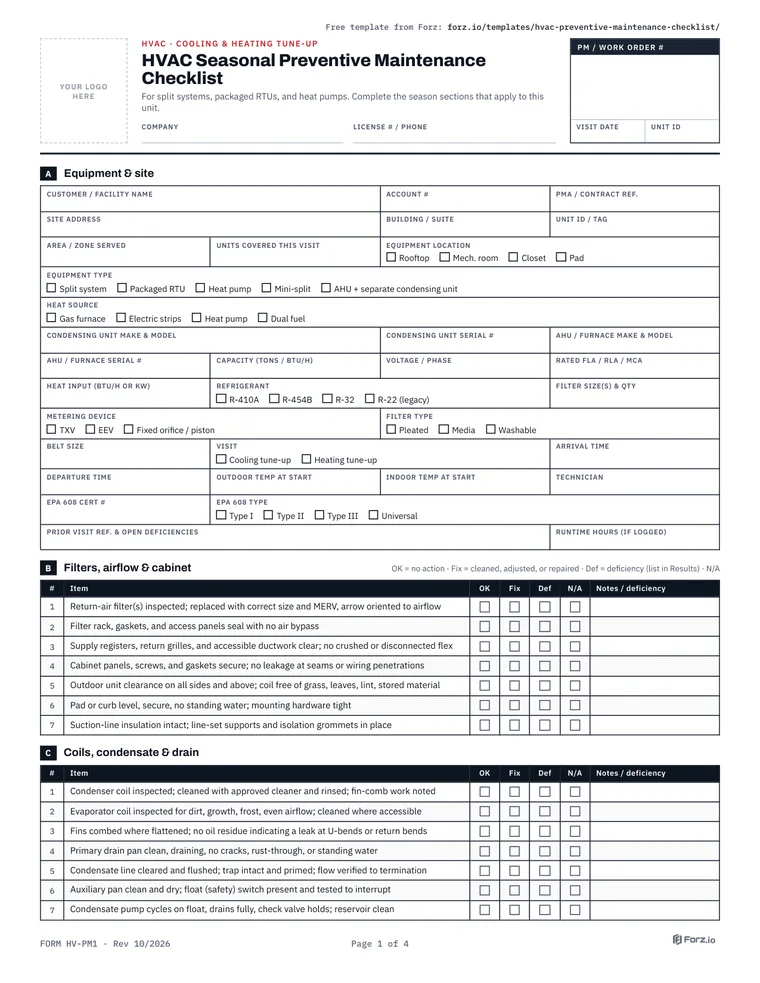
HVAC Seasonal Preventive Maintenance Tune-Up Checklist
HVAC · Checklist
Company: ______________
Date: ______________
Technician: ______________
Equipment & Site Information
- Customer / facility name, account number, and PMA or contract reference
- Site address, building, suite, and equipment location (rooftop / mechanical room / closet / pad)
- Unit ID or tag, area or zone served, and number of units covered this visit
- Equipment type: split system / packaged RTU / heat pump / mini-split / air handler with separate condensing unit
- Manufacturer, model number, and serial number (condensing unit and air handler / furnace)
- Nominal capacity (tons or BTU/h), nameplate voltage / phase, and rated FLA / RLA / MCA
- Refrigerant type (R-410A / R-454B / R-32 / R-22 legacy) and metering device (TXV / EEV / fixed orifice / piston)
- Heat source (gas furnace / electric heat strips / heat pump / dual fuel) and input BTU/h or kW rating
- Filter size(s), quantity, and type (pleated / media / washable); belt size where applicable
- Visit type and season (cooling tune-up / heating tune-up), date, arrival and departure time
- Outdoor ambient temperature and indoor space temperature at start of visit
- Technician name, company, and EPA Section 608 certification number (Type I / II / III / Universal)
- Reference to prior visit, open deficiencies, and equipment runtime hours where logged
Filters, Airflow & Cabinet
- Return-air filter(s) inspected; replaced with correct size, MERV rating, and airflow-direction arrow oriented to flow
- Filter rack, gaskets, and access panels seal with no air bypass around the filter
- Supply and return temperature split (delta-T) measured in cooling, typically 16 to 22 degrees F across the evaporator at normal indoor wet-bulb
- Static pressure measured across the coil and filter where ports allow; total external static compared to blower table
- Supply registers, return grilles, and accessible ductwork checked for blockage, crushed flex, and disconnected sections
- Cabinet panels, screws, and gaskets secure; no air leakage at seams or wiring penetrations
- Outdoor unit clearance verified, with the coil free of grass, leaves, dryer lint, and stored material on all sides and above
- Equipment pad or curb level, secure, and free of standing water; mounting hardware tight
- Refrigerant line-set insulation intact on the suction line; line-set supports and isolation grommets in place
Coils, Condensate & Drain
- Condenser coil inspected for dirt, bent fins, and damage; cleaned with approved coil cleaner and rinsed (note fin-comb work)
- Evaporator coil inspected for dirt, biological growth, frost, and even airflow; cleaned where accessible
- Coil fins combed straight where flattened; no refrigerant oil residue indicating a leak at U-bends or return bends
- Primary condensate drain pan clean, draining, and free of cracks, rust-through, or standing water
- Condensate drain line cleared and flushed; trap intact and primed; verified flow to termination
- Auxiliary / secondary drain pan clean and dry; float switch (safety) present and tested to interrupt on high water
- Condensate pump (where present) cycles on float, drains fully, and check valve holds; reservoir clean
- Drain pan treatment tablet or strip installed per agreement scope
- Blower wheel and housing inspected for dirt loading and imbalance; cleaned where fouled
Electrical, Motors & Controls
- Disconnect, breaker, and fuse sizing verified against nameplate MCA / max fuse; fuses and lugs tight
- All line- and low-voltage connections inspected and tightened; no discoloration, melted insulation, or burnt smell
- Contactor contacts inspected for pitting, burning, and chatter; coil voltage confirmed pull-in; replaced if pitted
- Run and start capacitor microfarad (uF) values measured against nameplate rating, and replaced if outside the manufacturer's stated tolerance (a drop of more than roughly 10 percent below rating is commonly cited) or bulged
- Compressor amp draw measured at running load and compared to RLA on nameplate
- Condenser fan motor amp draw and bearings checked; motor cleaned and lubricated where serviceable
- Indoor blower motor amp draw measured; ECM module or PSC capacitor and speed taps verified
- Belt-drive blower: belt inspected for cracks, glazing, and wear; tension and sheave alignment set; pulleys tight on shaft
- Blower and condenser-fan bearings checked for noise and play; lubricated per manufacturer spec where fitted
- Supply voltage (L1-L2-L3) and voltage imbalance checked; control transformer secondary voltage (24 VAC) confirmed
- Crankcase heater operational on units so equipped; low-ambient controls and head-pressure controls verified
- Safety controls tested, with high/low pressure switches, freeze stat, float switch, and limit interlocks reset and functional
Cooling Season: Refrigerant Charge & Readings
- System run in cooling for at least 15 minutes to stabilize before taking readings
- Suction (low-side) pressure and saturation temperature recorded
- Liquid (high-side) / discharge pressure and saturation temperature recorded
- Suction line temperature measured and superheat calculated (target-superheat method for fixed orifice; 8 to 12 degrees F typical for TXV)
- Liquid line temperature measured and subcooling calculated (compare to manufacturer target, commonly 8 to 12 degrees F)
- Indoor entering wet-bulb and outdoor dry-bulb recorded for target-superheat charging on fixed-orifice systems
- Compressor discharge line temperature checked for overheating; no signs of flooding or starving
- Refrigerant leak check performed (electronic detector, soap, or UV) at fittings, schrader cores, and coil where suspected
- Schrader caps and core seals verified; any refrigerant added recorded by type and weight on the EPA leak log
- TXV / EEV sensing bulb secure and insulated; superheat response confirmed
Heating Season: Gas Furnace & Combustion Safety
- Skip this section on electric-heat or heat-pump-only systems; complete the heat-pump heating section instead
- Burner assembly, flame sensor, and igniter (hot-surface or spark) inspected and cleaned; flame sensor microamp signal verified
- Burner flames observed steady and blue, with no lifting, rollout, or yellow tipping
- Gas supply and manifold pressure measured with a manometer and set to nameplate spec (commonly near 3.5 in. w.c. for natural gas and 10 to 11 in. w.c. for LP, but verify the nameplate)
- Gas piping, valve, and unions leak-checked at all connections; no leaks detected
- Heat exchanger inspected (visual and by camera where possible) for cracks, corrosion, rust scale, and separation
- Inducer motor, pressure switch, and condensate (high-efficiency) trap and tubing checked clear and operational
- Flue / vent connector, draft, and combustion-air openings inspected for blockage, corrosion, and proper pitch and clearance
- Combustion analysis performed (flue-gas O2 / CO2, stack temperature, and steady-state efficiency recorded)
- Ambient and flue carbon monoxide (CO) measured; CO in supply air checked; readings within safe limits and CO alarms confirmed present
- Temperature rise across the heat exchanger measured and confirmed within the nameplate rise range
- Limit switch, rollout switch, and gas-valve safety shutoff tested for correct operation
Heat Pump: Heating Mode & Defrost
- System run in heating; supply-to-return temperature rise (delta-T) measured, commonly 15 to 25 degrees F on air-source units
- Reversing valve shifts fully between cooling and heating with no internal bypass (no abnormal mid-line temperature)
- Defrost cycle initiated or verified: sensor, board timing, valve actuation, and outdoor-fan control confirmed
- Auxiliary / emergency electric heat strips energize on demand; sequencer staging and amp draw per strip verified
- Outdoor coil clear of ice and debris; base-pan drain open so meltwater does not refreeze
- Defrost termination sensor and ambient sensor checked; balance-point and lockout settings verified where set
- Heating-mode suction and discharge pressures and saturation temperatures recorded for charge verification
- Dual-fuel / hybrid changeover to gas furnace confirmed at the correct outdoor setpoint where applicable
Economizer, Dampers & Thermostat
- Economizer damper travels full open to full closed; actuator and linkage move freely with no binding or slop
- Outdoor-air, return-air, and mixed-air sensors checked against a reference thermometer; readings within tolerance
- Economizer changeover setpoint (dry-bulb or enthalpy) and minimum-position setting verified per sequence
- Damper blade seals and gaskets intact; barometric relief or power exhaust operates with the economizer
- Fresh-air / outside-air intake and louvers clear; bird screen and rain hood intact
- Thermostat / controller mode, setpoints, and schedule confirmed with the customer; staging and fan settings correct
- Thermostat calibration checked against a reference; remote sensors reading accurately
- Thermostat batteries replaced where applicable; control wiring and terminals secure
- Building automation / BAS or smart-controller alarms reviewed and cleared where present
Results, Deficiencies & Sign-Off
- Overall result: system operating normally / deficiencies noted / repair required / unit red-tagged or shut down for safety
- Each deficiency described with unit ID, component, measured reading vs. spec, and severity (safety / efficiency / monitor)
- Safety condition found (cracked heat exchanger, high CO, refrigerant leak, electrical hazard), action taken, and customer notified
- Refrigerant added or recovered recorded by type and weight; EPA leak rate noted if a leak was found on a covered appliance
- Recommended repairs and replacements listed with priority and a quote, estimate, or work-order reference
- Photos, combustion-analysis printout, and meter readings attached (count and reference numbers)
- Filters, belts, and consumables installed this visit recorded with sizes and quantities
- Next PM visit (cooling / heating) scheduled and next-due date recorded
- Customer or representative notified of findings (name, contact, and date)
- Technician printed name, signature, EPA certification number, and date
- Customer / authorized representative printed name, signature, and date
Technician signature
Customer / owner signature
This checklist is a general planned-maintenance starting point compiled from publicly available HVAC manufacturer and industry maintenance guidance current as of 2026; it is not a manufacturer procedure and does not replace the specific maintenance, charging, and combustion specifications in the equipment's installation and service manual. Refrigerant superheat, subcooling, gas manifold pressure, temperature rise, capacitor tolerance, and amp-draw figures shown are commonly cited ranges only. Always confirm targets against the unit nameplate and manufacturer literature for the exact model and refrigerant. Combustion testing, refrigerant handling, and gas work must be performed by qualified personnel; EPA Section 608 certification is required to handle refrigerant, and any carbon-monoxide, gas-leak, or cracked-heat-exchanger finding requires immediate corrective action. Codes, editions of referenced standards (such as the fuel-gas and mechanical codes), and locally adopted amendments vary; verify scope, safety thresholds, and frequencies with your AHJ and the adopted edition. This template does not replace inspection, testing, and maintenance by qualified personnel.
Stop filling out paper forms
This same checklist runs in the Forz mobile app, where you also get photo documentation, digital signatures, automatic certificates, and recurring schedules so the next one books itself.
See how digital inspections work →Run inspections without the paperwork
Forz turns checklists like this one into mobile workflows. Techs complete them in the field with photos, and Forz files them automatically.