HVAC Service Work Order
This complete HVAC service work order for commercial and residential calls covers equipment identity, reported problem, diagnosis, full refrigerant-circuit and airflow readings, EPA-aligned refrigerant tracking, parts, labor, and a dual sign-off. Download the PDF for the truck, copy the Excel file into your own paperwork, or use it as the checklist a tech works through on every call. Forz runs this same work order digitally: techs capture readings, before-and-after photos, and customer signatures from the iOS or Android app offline, pull job details from a job template, and tie recurring maintenance visits to a recurring schedule that auto-generates each job.
Fill this out on your phone with Forz → Get a free demo · see the mobile apps
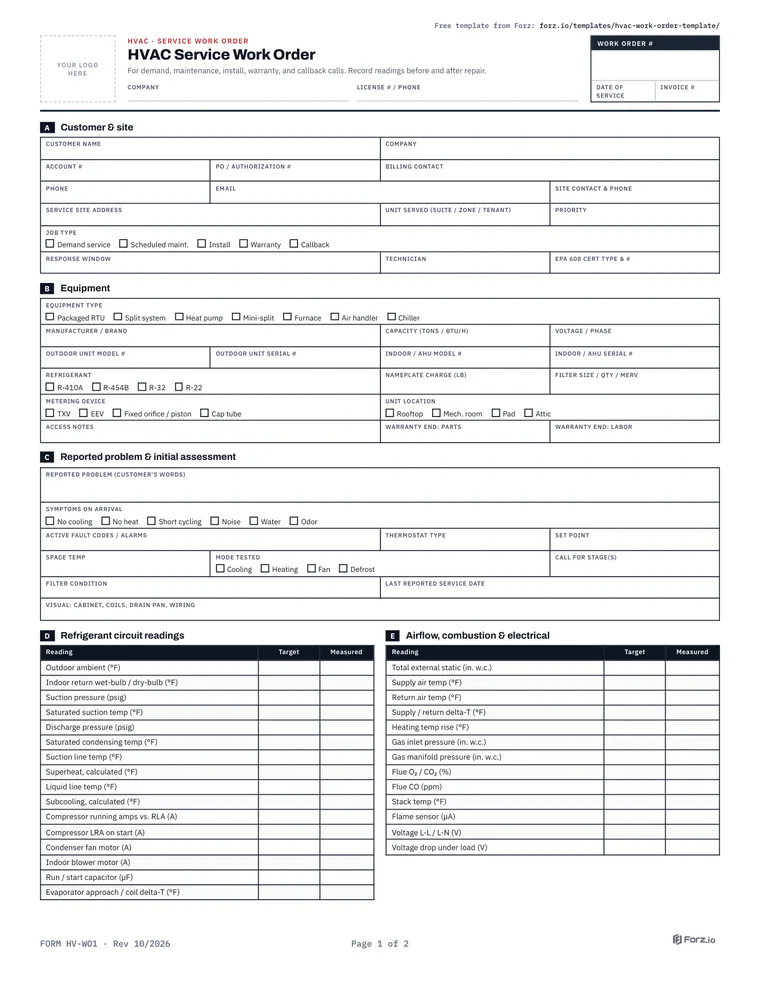
HVAC Service Work Order
HVAC · Form
Company: ______________
Date: ______________
Technician: ______________
Work Order & Site Information
- Work order number and date of service
- Customer name, company, and account number
- Billing contact, phone, and email
- Service site address and unit served (suite, zone, or tenant)
- Site contact name and phone on arrival
- Purchase order or authorization reference number
- Job type (demand service, scheduled maintenance, install, warranty, callback)
- Dispatched priority and requested response window
- Technician name and EPA Section 608 certification type and number
Equipment Identification
- Equipment type (packaged RTU, split system, heat pump, mini-split, furnace, air handler, chiller)
- Manufacturer / brand
- Model number (outdoor / condensing unit)
- Serial number (outdoor / condensing unit)
- Indoor unit or air handler model and serial number
- Nominal capacity (tons or BTU/h) and voltage / phase
- Refrigerant type (R-410A, R-454B, R-32, R-22) and factory / nameplate charge (lbs)
- Metering device type (TXV, EEV, fixed orifice / piston, cap tube)
- Filter size(s), quantity, and MERV rating
- Unit location (rooftop, mechanical room, pad, attic) and access notes
- Parts and labor warranty status with end dates
Reported Problem & Initial Assessment
- Reported problem in customer's words
- Symptoms observed on arrival (no cooling, no heat, short cycling, noise, water, odor)
- Thermostat type, set point, and current space temperature
- Mode tested (cooling, heating, fan, defrost) and call for stage(s)
- Visual condition of cabinet, coils, drain pan, and wiring
- Active fault codes or alarms displayed at unit or board
- Filter condition and last reported service date
Refrigerant Circuit Readings
- Outdoor ambient temperature (°F) and indoor return wet-bulb / dry-bulb
- Suction (low-side) pressure and saturated suction temperature
- Discharge (high-side) pressure and saturated condensing temperature
- Suction line temperature and calculated superheat (°F)
- Liquid line temperature and calculated subcooling (°F)
- Target superheat / subcooling per metering device and manufacturer chart
- Compressor running amps vs. nameplate RLA; LRA on start
- Condenser fan and indoor blower motor amp draw
- Run / start capacitor microfarad reading vs. rated µF
- Contactor, reversing valve, and crankcase heater condition
- Evaporator approach / delta-T across the indoor coil
Airflow, Combustion & Electrical
- Total external static pressure (in. w.c.) vs. design (typical target ≈ 0.5 in. w.c.)
- Supply and return air temperatures and measured delta-T
- Heating temperature rise (°F) vs. furnace nameplate range
- Gas manifold / inlet pressure (in. w.c.) on call for heat
- Combustion analysis: flue O2 / CO2, CO (ppm), and stack temperature
- Flame sensor microamps and ignitor / inducer operation
- Heat exchanger inspection result (cracks, corrosion, soot)
- Incoming voltage L-L / L-N and voltage drop under load
- Condensate drain flow, trap, float switch, and pan condition
- Belt, bearings, sheave alignment, and economizer / damper operation (if equipped)
Refrigerant Tracking (EPA 608 / AIM Act)
- Refrigerant added: type, amount (lbs / oz), and cylinder lot or ID
- Refrigerant recovered: amount (lbs / oz) and recovery cylinder ID
- Full charge of appliance (lbs) used for leak-rate calculation
- Leak inspection method (electronic detector, bubble, UV, nitrogen / standing pressure) and result
- Leak location(s) found and repair performed, or follow-up scheduled
- Calculated leak rate (% of full charge) if refrigerant was added
- Verification / follow-up leak test performed and result
- Recovery / reclaim disposition and certified equipment used
- Technician EPA 608 certification number and date
Diagnosis & Work Performed
- Root cause / failure identified
- Corrective work performed this visit
- Components tested, cleaned, adjusted, or replaced
- System performance verified after repair (readings re-checked)
- Before-and-after photos taken and attached
- Conditions outside scope or requiring shutdown / lockout
Parts, Materials & Labor
- Part number, description, and quantity used
- Part source (truck stock, supplier, warranty claim, customer-supplied)
- Unit price and line total per part
- Materials and shop supplies used
- Arrival and departure times; total time on site
- Regular vs. overtime labor hours and rate
- Trip / diagnostic fee and labor subtotal
Recommendations, Results & Sign-Off
- Equipment left operational, partially operational, or down (state reason)
- Open deficiencies and safety concerns noted
- Recommended repairs or replacements with estimated priority
- Quoted follow-up work; mark each item approved or declined by customer
- Maintenance interval recommended for next visit
- Summary of charges: parts, labor, materials, tax, and total
- Payment method or terms
- Customer printed name, signature, and date (work and charges authorized)
- Technician printed name, signature, EPA cert number, and date
- Office review / invoice number
Technician signature
Customer / owner signature
Any diagnostic target shown here (for example a total external static pressure near 0.5 in. w.c.) is a commonly cited starting point. Always charge and verify superheat, subcooling, static pressure, and temperature rise against the equipment manufacturer's nameplate, charging chart, and published specifications for the specific unit and metering device. Refrigerant recordkeeping requirements vary by refrigerant type and appliance charge. EPA Section 608 covers regulated refrigerants, and under the AIM Act the leak-repair and recordkeeping framework applies to HFC appliances at lower charge thresholds (commonly cited as 15 lbs as of January 1, 2026); leak-rate calculations are generally required whenever refrigerant is added, and records are typically kept for at least three years. Only EPA 608-certified technicians may open the refrigerant circuit. Editions and locally adopted amendments vary; verify scope and frequencies with your AHJ and the adopted edition. This template is a starting point, not the standard, and does not replace inspection, testing, or charging procedures performed by qualified personnel.
Stop filling out paper forms
This same form runs in the Forz mobile app, where you also get photo documentation, digital signatures, automatic certificates, and recurring schedules so the next one books itself.
See how digital inspections work →Run inspections without the paperwork
Forz turns checklists like this one into mobile workflows. Techs complete them in the field with photos, and Forz files them automatically.