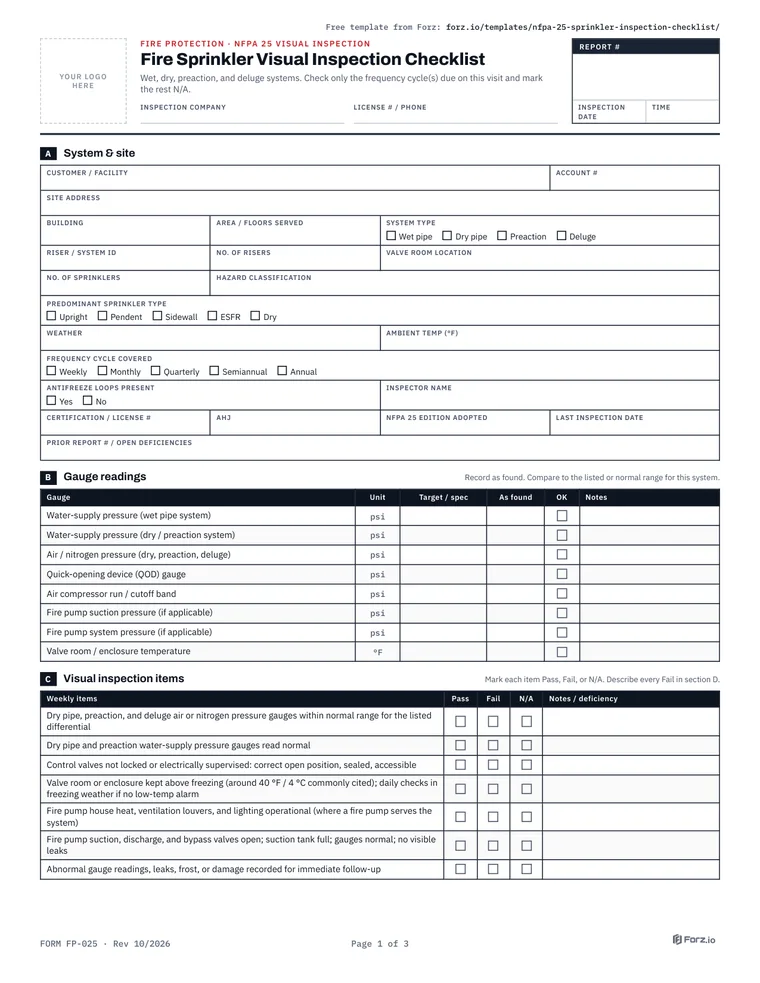
NFPA 25 Fire Sprinkler Visual Inspection Checklist
NFPA 25 organizes the visual inspection of water-based sprinkler systems into weekly, monthly, quarterly, semiannual, and annual cycles, with frequencies that differ between wet pipe, dry pipe, preaction, and deluge systems. This checklist consolidates the visual (inspection-only) items into one record you can complete on site and keep on file for the building owner and your AHJ — it does not cover the flow tests, trip tests, or hydrostatic tests that NFPA 25 also requires. Print it as-is, or run the same items digitally in Forz, where each device carries its own inspection frequency (Forz supports 14 configurable frequencies from daily through every 7 years), technicians record Pass, Fail, or Bypass results with photos in the field on the iOS and Android apps, and customers download the completed inspection PDF from the Customer Portal.
NFPA 25 Fire Sprinkler Visual Inspection Checklist
Fire Protection · Checklist
Company: ______________
Date: ______________
Technician: ______________
System & Site Information
- Customer / facility name and account number
- Site address, building, and area or floors served
- System type — wet pipe / dry pipe / preaction / deluge
- Riser or system ID, number of risers, and location of valve room
- Number of sprinklers and predominant sprinkler type (upright / pendent / sidewall / ESFR / dry)
- Hazard classification and whether antifreeze loops are present
- Inspection date, time, and frequency cycle covered (weekly / monthly / quarterly / semiannual / annual)
- Weather and ambient temperature at time of inspection
- Inspector name, company, and license or certification number
- Authority having jurisdiction (AHJ) and NFPA 25 edition adopted locally
- Date of last inspection and reference to prior report or open deficiencies
Weekly Visual Items
- Dry pipe, preaction, and deluge air or nitrogen pressure gauges read within normal range for the listed differential
- Dry pipe and preaction system water-supply pressure gauges read normal
- Control valves that are not locked or electrically supervised verified in the correct open position, sealed, and accessible
- Valve room or enclosure kept above freezing (a minimum around 40 degrees F / 4 degrees C is commonly cited) — inspect daily during freezing weather where no low-temperature alarm is installed; weekly where a low-temperature alarm is present
- Fire pump house heat, ventilation louvers, and lighting confirmed operational (where a fire pump serves the system)
- Fire pump suction, discharge, and bypass valves open; suction reservoir or tank full; suction and system pressure gauges normal; no visible leaks (where applicable)
- Abnormal gauge readings, leaks, frost, or damage recorded for immediate follow-up
Monthly Visual Items
- Wet pipe system water-supply pressure gauge reads normal supply pressure and is maintained
- All gauges in good condition, legible, and free of physical damage or fogging
- Control valves that are locked or electrically supervised verified in the correct open position, accessible, free of external leaks, and with no tampering
- Control valve identification signs present, legible, and securely attached
- Post indicator valves (PIV) show OPEN, target visible, and operating wrench in place
- Alarm valve and system riser exterior free of physical damage; trim and retard chamber valves in correct position
- Dry pipe / preaction valve exterior free of physical damage; trim valves in the correct open or closed position
- Dry pipe valve intermediate chamber not leaking through the drip check
- Quick-opening device (QOD) gauge reading consistent with the dry pipe valve system-side gauge; QOD control valve open
- Air compressor and low-air alarm pressure switch free of damage; wiring and air line connections secure; compressor maintains pressure within the listed run/cutoff band
- Backflow preventer assembly visible, undamaged, with both shutoff valves open (where reduced-pressure or double-check assembly is installed)
Quarterly Visual Items
- Waterflow alarm devices (vane, paddle, and pressure-switch type) free of physical damage and securely mounted
- Valve supervisory (tamper) switches free of physical damage and securely mounted
- Fire department connection (FDC) visible, accessible, and identified by sign
- FDC caps or plugs in place and undamaged; gaskets present; swivels and threads clear; interior free of obstruction
- FDC check valve not leaking and automatic ball-drip / drain valve in place and clear
- FDC piping and couplings undamaged and clear of stored materials, vehicles, and landscaping
- Hydraulic design information nameplate attached at the riser, legible, and matching the system
- Pressure-reducing and pressure-control valves in the correct position, not leaking, and handwheel in place (where installed)
- Hose connections, hose, gaskets, and hose-rack pressure-restricting devices undamaged and in place (combined standpipe systems)
Semiannual Visual Items
- Valve enclosure and heat source rechecked for adequacy before the heating season where freezing is a concern
- Dry pipe and preaction valve trim, drip checks, and low-point auxiliary drains confirmed free of accumulated condensate prior to onset of cold weather
- Gauges on the dry pipe, preaction, or deluge valve and across the alarm check valve compared for consistency with the differential
- Supervisory and waterflow signal wiring conduit, mounting, and connections visually free of corrosion or damage
- Note any vane / paddle / pressure-switch waterflow devices and tamper switches due for their semiannual functional test (scheduled separately)
- Pressure-reducing valves serving hose connections and hose racks visually checked for the correct set position and no external leakage (full flow test scheduled separately)
Annual Visual Items
- Sprinklers inspected from floor level — no leakage, corrosion, foreign material, paint, physical damage, or loading; orientation correct for the listing
- Sprinklers showing signs of corrosion, loading, or wrong type flagged for replacement; heads beyond their listed service life noted (a baseline near 50 years is commonly cited; dry, fast-response, residential, and harsh-environment heads typically use shorter intervals — confirm against the listing and adopted edition)
- Required clearance maintained from deflectors to storage, ductwork, and obstructions below
- Pipe and fittings free of mechanical damage, leakage, external corrosion, and misalignment; no external load bearing on the piping
- Hangers, sway bracing, and seismic restraints in place, secure, undamaged, and not loose
- Pipe identification, system control, and general information signs at the riser legible and secure
- Spare sprinkler cabinet stocked with the correct quantity and types of spares (a minimum of around 6 scaled by sprinkler count is commonly cited) plus the matching sprinkler wrench and an up-to-date spares list
- Building survey for changes in occupancy, use, or storage arrangement that affect adequacy of the design (evaluation only)
- Information sign noting antifreeze, dry, preaction, deluge, or auxiliary system features present and legible
- Low-temperature alarms in valve enclosures inspected toward the start of the heating season and free of physical damage
Antifreeze & Cold-Weather Items
- Antifreeze loop identified, mapped, and labeled at the riser and fill point
- Antifreeze solution sample drawn from the top and bottom of each system and concentration tested before onset of freezing weather (commonly an annual check)
- Measured concentration recorded and within listed limits — concentration caps commonly cited for legacy non-listed solutions (often around 30 percent propylene glycol or 38 percent glycerin by volume) are edition-dependent; confirm against the listed antifreeze and AHJ acceptance
- Listed (factory-premixed) antifreeze confirmed where required; legacy non-listed solutions flagged for the owner per the antifreeze sunset requirements
- Low-point and auxiliary (drum) drains on dry and preaction systems drained of condensate before freezing weather
- Heat trace, enclosure heaters, and freeze protection on exposed piping and FDC confirmed operational
- Exposed or unheated areas, attic spaces, and loading docks checked for piping exposed to freezing
Referenced Periodic Items (Verify Schedule — Not Part of the Visual Cycle)
- Gauges replaced or tested against a calibrated gauge on the periodic interval commonly cited as 5 years (record manufacture date and last calibration)
- Internal inspection for obstructing material on its periodic interval (commonly cited as 5 years) scheduled and last completion date recorded
- Internal inspection of dry pipe / preaction valves, alarm valves, and check valves scheduled on their periodic intervals per the adopted edition
- Main drain test (typically quarterly where supplied through a backflow or PRV, otherwise annually) and waterflow / alarm tests scheduled
- Dry pipe valve trip tests (typically an annual partial trip with a periodic full-flow trip) and deluge full trip test scheduled with qualified personnel
- Fire department connection supply piping hydrostatic test and standpipe flow / hydrostatic testing scheduled on their periodic intervals where applicable
Results, Deficiencies & Sign-Off
- Overall result — pass / deficiencies noted / critical deficiency / impairment in effect
- Each deficiency or impairment described with location, severity (critical / noncritical / impairment), and NFPA 25 reference where known
- Impairment procedures followed — system tagged, owner and AHJ/monitoring company notified, fire watch in place where required
- Corrective action recommended with priority and a work order, proposal, or quote reference
- Photos and measurements attached (count and reference numbers)
- Owner or representative notified of deficiencies — name, contact, and date
- Next inspection due date(s) by frequency cycle
- Inspector printed name, signature, certification number, and date
- Owner / authorized representative printed name, signature, and date
Technician signature
Customer / owner signature
Items above are summarized from publicly available NFPA 25 guidance current as of 2026 and cover visual inspection only — not the tests and maintenance NFPA 25 also requires. Frequencies differ by system type and some items shown (such as waterflow-device, tamper-switch, antifreeze, gauge, and obstruction items) carry separate test or replacement intervals. Editions and locally adopted amendments vary; verify the scope and frequencies against your AHJ and the adopted edition of NFPA 25, and confirm sprinkler service-life and antifreeze limits against the specific listings. This template is a starting point for your inspection records — it is not the standard, and it does not replace inspection, testing, and maintenance by qualified personnel.
Stop filling out paper forms
This same checklist lives in the Forz mobile app — with photo documentation, digital signatures, automatic certificates, and recurring schedules so the next one books itself.
See how digital inspections work →Run inspections without the paperwork
Forz turns checklists like this one into mobile workflows — completed in the field, documented with photos, and filed automatically.