Elevator Maintenance Checklist (MCP-Aligned)
ASME A17.1/CSA B44, the safety code adopted in most US and Canadian jurisdictions, commonly requires every elevator to be maintained under a documented Maintenance Control Program (MCP), with written task records for each visit kept on site with the unit. This checklist walks the unit the way a mechanic does: machine room and drive, suspension and governor, hoistway and car top, pit, doors and interlocks, car operation, and the periodic-test references that close the file. Download the PDF and clip it to the MCP binder, or run it in Forz as a recurring inspection that records Pass, Fail, or Bypass per device with photos, captures the mechanic's signature on the mobile app, and auto-schedules the next monthly, quarterly, or annual visit from the device's inspection frequency.
Fill this out on your phone with Forz → Get a free demo · see the mobile apps
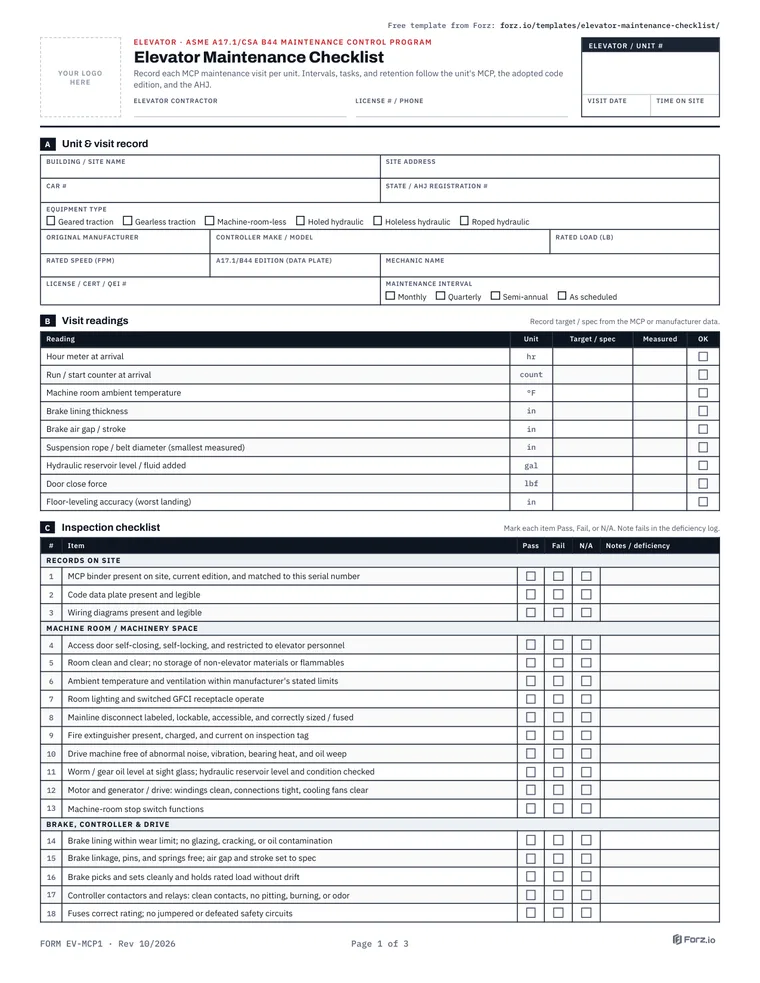
Elevator Maintenance Checklist (MCP-Aligned)
Elevator · Checklist
Company: ______________
Date: ______________
Technician: ______________
Unit & Visit Record
- Building or site name and full address
- Unit ID, car number, and state or AHJ serial/registration number
- Equipment type: geared traction, gearless traction, machine-room-less, holed or holeless hydraulic, or roped hydraulic
- Original manufacturer, controller make/model, and rated load and speed
- Date and time on site; arrival reading on hour/run meters if equipped
- Mechanic name and license, mechanic certification, or QEI number
- Maintenance interval per the unit MCP: monthly, quarterly, semi-annual, or as scheduled
- MCP binder present on site, current edition, and matched to this serial number
- Code data plate present and legible; A17.1/B44 edition noted
Machine Room / Machinery Space
- Access door self-closing, self-locking, and restricted to elevator personnel
- Room clean and clear, with no storage of non-elevator materials or flammables
- Ambient temperature and ventilation within the manufacturer's stated limits
- Room lighting and switched GFCI receptacle operate
- Mainline disconnect labeled, lockable, accessible, and correctly sized/fused
- Fire-extinguisher present, charged, and current on inspection tag
- Drive machine free of abnormal noise, vibration, bearing heat, and oil weep
- Worm/gear oil level at sight glass; hydraulic reservoir level and condition checked; fluid added recorded
- Motor and generator/drive: windings clean, connections tight, cooling fans clear
- Wiring diagrams present and legible; machine-room stop switch functions
Brake, Controller & Drive
- Brake lining thickness within wear limit; no glazing, cracking, or oil contamination
- Brake linkage, pins, and springs free; air gap and stroke set to spec
- Brake picks and sets cleanly and holds rated load without drift
- Controller contactors and relays with clean contacts and no pitting, burning, or odor
- Fuses correct rating; no jumpered or defeated safety circuits
- Resistors, reactors, and drive heatsinks clean and clear of dust
- Solid-state drive fault log reviewed; capacitor/cooling-fan condition checked
- Selector, encoder, or tape-head reading accurately; couplings secure
- Battery-lowering / emergency power circuit and battery condition checked
- Ground connections and bonding verified tight
Suspension, Traction & Governor
- Suspension ropes or belts: broken wires, crown/valley wear, and diameter reduction measured against criteria
- Rope lubrication, tension equalized across ropes, and hitch/shackle springs sound
- Traction sheave groove profile checked for wear; no rope crossover or excessive throw-off
- Deflector, secondary, and overhead sheaves with quiet bearings and guards in place
- Compensation ropes/chains and tie-downs checked for wear and proper hang
- Governor rope free, lubricated, and tension sheave riding correctly in pit
- Governor jaws, flyweights, and pivots free; seals intact on adjustment means
- Governor overspeed and tripping switches operate; reset device functions per MCP
- Hydraulic jack, packing, and fittings checked for leaks; scavenger pump operates
Hoistway & Car Top
- Car-top inspection station: stop switch, run/enable, and constant-pressure controls function
- Car-top light, GFCI receptacle, and railing/standing surface secure where required
- Hoistway clean and dry, with rails, brackets, and sills free of dirt and excess oil
- Guide rails plumb; roller guides or slide-guide shoe gibs within wear limits and lubricated
- Rail lubricators filled and feeding; no rail rust or scoring
- Traveling cable free of chafing, kinks, and snags; properly looped and clamped
- Leveling, slowdown, and directional limit switches and cams secure and operating
- Normal and final terminal stopping devices checked along travel
- Counterweight frame, filler weights, tie rods, and guides secure and within run-by
- Crosshead data plate present and legible; overhead clearance unobstructed
Pit & Buffers
- Pit stop switch and pit light operate; GFCI receptacle works
- Pit ladder secure, accessible, and extending to the required height
- Pit clean and dry (any water, oil, or debris noted, cause traced, and removed)
- Sump pump and float switch tested where installed; no oil discharged to drain
- Spring buffers secure and plumb; oil-buffer oil level at sight glass and plunger free
- Buffer-support and car/counterweight run-by and bottom clearances verified
- Car and counterweight safety jaws clean, free, and set to rail; linkage and rollers lubricated
- Governor tension sheave assembly, switch, and guard secure
- Refuge space, toe guard, and lower hoistway access switches checked
Doors, Interlocks & Car Operation
- Hoistway door interlocks engage and lock; car will not move with any door unlocked
- Restrictor / unlocking-zone device prevents car-door opening outside the landing zone
- Door hangers, tracks, gibs, rollers, and up-thrust eccentrics checked full travel
- Door closers, spirator/closer springs, and relating cables/tapes operate
- Door operator lubricated; close force at or below limit and close speed/kinetic energy normal
- Reopening device (light curtain or safety edge) stops and reopens closing doors
- Car and hall buttons, lanterns, position indicators, and gongs function
- Car lighting, emergency light, and alarm bell operate; fan/ventilation works
- Two-way emergency communication tested both directions; location ID and help-arriving signal verified
- Floor-leveling accuracy and re-leveling checked at landings served; ride quality noted
- Firefighters' Emergency Operation Phase I recall and Phase II in-car operation tested per schedule
- Emergency exit panel and car-top exit secured; load weighing/dispatch features checked
Periodic Testing & Sign-Off
- Category 1 (annual) test due/last date noted: no-load safety, governor, terminal devices, buffers, FEO
- Category 5 (5-year) test due/last date noted: full-load/static, governor trip speed, safety, relief valve
- Relief-valve setting and pressure-vessel data recorded for hydraulic units (per AHJ)
- Routine tasks performed this visit recorded with date and mechanic
- Tests, adjustments, repairs, and replacements recorded with date and reason
- Callbacks/entrapments since last visit and corrective action recorded
- Parts replaced and materials/lubricants used listed
- Deficiencies, code violations, and follow-up items noted; owner/manager notified in writing
- Operating certificate current and posted per AHJ; MCP records on site and within retention period
- Mechanic signature, license/cert number, and date
- Owner/manager or witnessing QEI signature and date
Technician signature
Customer / owner signature
ASME A17.1/CSA B44 editions and locally adopted amendments vary by jurisdiction. Your authority having jurisdiction (AHJ), the adopted code edition, and the manufacturer's written procedures govern the scope, intervals, tasks, and record-retention for your Maintenance Control Program; on-site retention of five years is commonly cited but verify locally. Category 1 and Category 5 tests must be performed by qualified elevator personnel and, where required, witnessed by a Qualified Elevator Inspector. This template is a starting point, not the standard, and does not replace inspection or testing by qualified personnel. Verify scope and frequencies with your AHJ and the adopted edition.
Stop filling out paper forms
This same checklist runs in the Forz mobile app, where you also get photo documentation, digital signatures, automatic certificates, and recurring schedules so the next one books itself.
See how digital inspections work →Run inspections without the paperwork
Forz turns checklists like this one into mobile workflows. Techs complete them in the field with photos, and Forz files them automatically.