Fire Extinguisher Monthly Inspection Log (NFPA 10)
NFPA 10 requires every portable fire extinguisher to be visually inspected when first placed in service and at least monthly thereafter at intervals not exceeding roughly 30 days, with the inspection recorded and the most recent records retained for at least 12 months. This tag-style log carries one extinguisher through a full year on a single sheet: unit identification, the recurring 30-day visual checks, a 12-row month-by-month record block, deficiency tracking, and the long-interval service dates a building owner has to stay ahead of. Download the PDF and print one sheet per extinguisher, or run the same program in Forz with per-device inspection schedules, Pass/Fail/Bypass results, photo documentation, and digital signatures captured in the mobile app, plus recurring schedules that surface the annual, 6-year, and hydrostatic due dates automatically.
Fill this out on your phone with Forz → Get a free demo · see the mobile apps
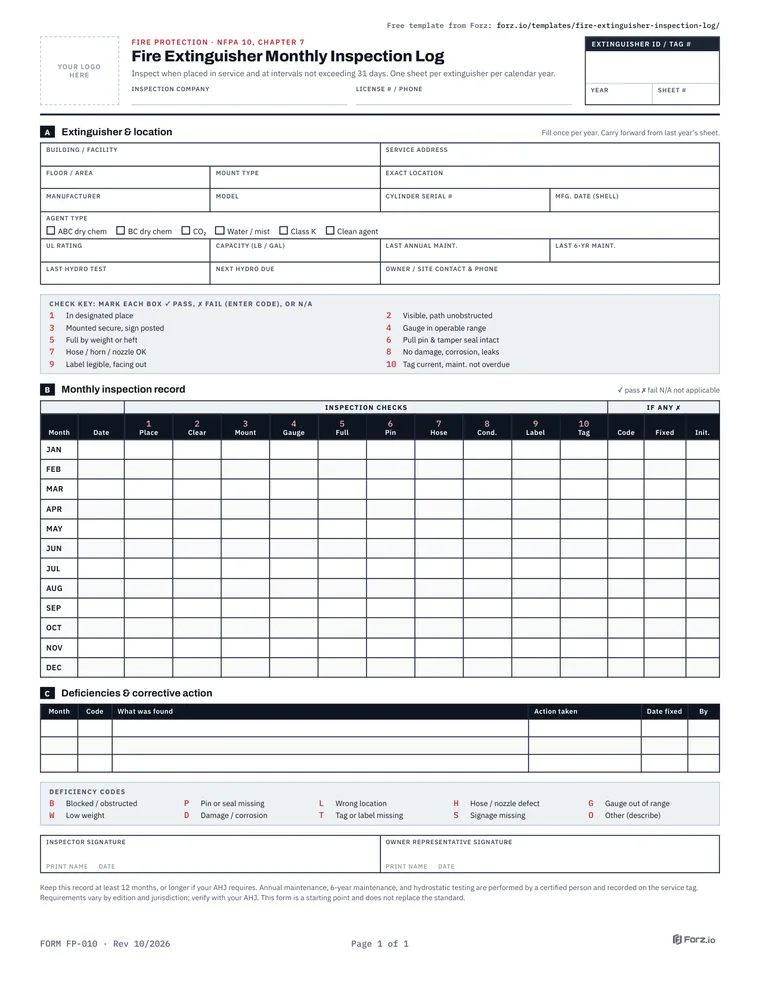
Fire Extinguisher Monthly Inspection Log (NFPA 10)
Fire Protection · Log
Company: ______________
Date: ______________
Technician: ______________
Extinguisher Identification & Site Information
- Building or facility name
- Service address: street, city, state, ZIP
- Floor, suite, department, or zone
- Location description: wall bracket, recessed cabinet, vehicle, or stand
- Extinguisher ID, asset tag, or barcode number
- Manufacturer and model number
- Cylinder serial number
- Agent type and UL rating (for example 4-A:80-B:C ABC dry chemical, CO2, Class K wet chemical, water mist)
- Rated capacity in pounds (dry chemical/CO2) or gallons (water/Class K)
- Rechargeable or non-rechargeable (disposable) unit
- Date of manufacture stamped on shell
- Calendar year covered by this log sheet
Monthly Visual Inspection Checks: Repeat Every 30 Days
- Extinguisher is in its designated location, properly mounted, and not blocked from view
- Path to the extinguisher is clear, with nothing stacked, parked, or stored in front of it
- Mounting height and bracket secure; commonly cited mounting guidance puts the top of heavier units (typically over 40 lb) no higher than about 3.5 ft, lighter units no higher than about 5 ft, with several inches of clearance to the floor
- Location signage and ID marking present and visible from the approach
- Pressure gauge needle reads in the operable (green) range, not in the recharge or overcharge zone (N/A on CO2 and cartridge-operated units)
- Hefted or weighed to confirm the unit feels full and the agent has not leaked or settled
- Pull pin seated and the tamper seal intact and unbroken
- Discharge hose, horn, or nozzle present, attached, and free of cracks, cuts, or blockage
- Shell, handle, lever, and carrying handle free of dents, gouges, corrosion, or leakage
- Operating instructions and HMIS/agent-type label legible and facing outward
- Inspection tag or label attached, current, and with room for this month's entry
- Last annual maintenance and hydrostatic dates on the service collar are not past due
12-Month Inspection Record: One Row Per Month
- January: inspection date, gauge reading, pin/seal OK, condition OK, deficiency code, inspector initials
- February: inspection date, gauge reading, pin/seal OK, condition OK, deficiency code, inspector initials
- March: inspection date, gauge reading, pin/seal OK, condition OK, deficiency code, inspector initials
- April: inspection date, gauge reading, pin/seal OK, condition OK, deficiency code, inspector initials
- May: inspection date, gauge reading, pin/seal OK, condition OK, deficiency code, inspector initials
- June: inspection date, gauge reading, pin/seal OK, condition OK, deficiency code, inspector initials
- July: inspection date, gauge reading, pin/seal OK, condition OK, deficiency code, inspector initials
- August: inspection date, gauge reading, pin/seal OK, condition OK, deficiency code, inspector initials
- September: inspection date, gauge reading, pin/seal OK, condition OK, deficiency code, inspector initials
- October: inspection date, gauge reading, pin/seal OK, condition OK, deficiency code, inspector initials
- November: inspection date, gauge reading, pin/seal OK, condition OK, deficiency code, inspector initials
- December: inspection date, gauge reading, pin/seal OK, condition OK, deficiency code, inspector initials
Deficiency Legend & Corrective Action
- Codes for the record block: B blocked/obstructed, L wrong location, G gauge out of range, P pin or seal missing, D damage/corrosion, H hose or nozzle defect, W low weight, T tag/label missing or illegible, S missing signage
- Deficiency found: month and brief description of the failed check
- Date deficiency identified
- Action taken: recharge, hydrostatic test, repair, or replace
- Date removed from service and tagged out
- Temporary replacement unit ID placed in this location
- Servicing company and technician performing the correction
- Date returned to service and re-verified
Annual Maintenance & Long-Interval Service Tracking
- Last annual maintenance date, servicing company name, and technician ID on the service tag
- Next annual maintenance due (within 1 year, commonly cited 12-month interval)
- 6-year internal examination due (applies to rechargeable stored-pressure units subject to a 12-year hydrostatic test, such as dry chemical)
- Last 6-year internal exam date and verification stamp
- Hydrostatic test interval, commonly cited as 5 years for water, CO2, and wet chemical (Class K) and 12 years for dry chemical and halogenated agents
- Last hydrostatic test date and next hydrostatic test due
- Non-rechargeable units: removed-from-service date, commonly cited as 12 years from date of manufacture
- Six-year/hydrostatic collar or service certificate on file
Results Summary & Sign-Off
- Total extinguishers covered by this sheet and overall result (Pass / Fail / Out of Service)
- Open deficiencies remaining at end of this log year
- All deficiencies above corrected and verified (Yes / No)
- Inspector / technician name (printed)
- Inspector / technician license or certification number
- Inspector / technician signature and date
- Owner / facility representative name (printed)
- Owner / facility representative signature and date
Technician signature
Customer / owner signature
Editions of NFPA 10 and locally adopted amendments vary, and your authority having jurisdiction (AHJ) may adopt requirements beyond the standard's minimums; verify the inspection scope, intervals, mounting and clearance requirements, hydrostatic schedule, and recordkeeping with your AHJ and the edition adopted in your jurisdiction. Intervals and dimensions shown here (monthly visual, annual maintenance, 6-year internal exam, 5-/12-year hydrostatic test, and mounting heights/clearances) are commonly cited and can be edition- and agent-dependent. This template is a starting point, not the standard, and does not replace inspection, maintenance, hydrostatic testing, or recharging performed by qualified personnel and a licensed fire protection contractor.
Stop filling out paper forms
This same log runs in the Forz mobile app, where you also get photo documentation, digital signatures, automatic certificates, and recurring schedules so the next one books itself.
See how digital inspections work →Run inspections without the paperwork
Forz turns checklists like this one into mobile workflows. Techs complete them in the field with photos, and Forz files them automatically.