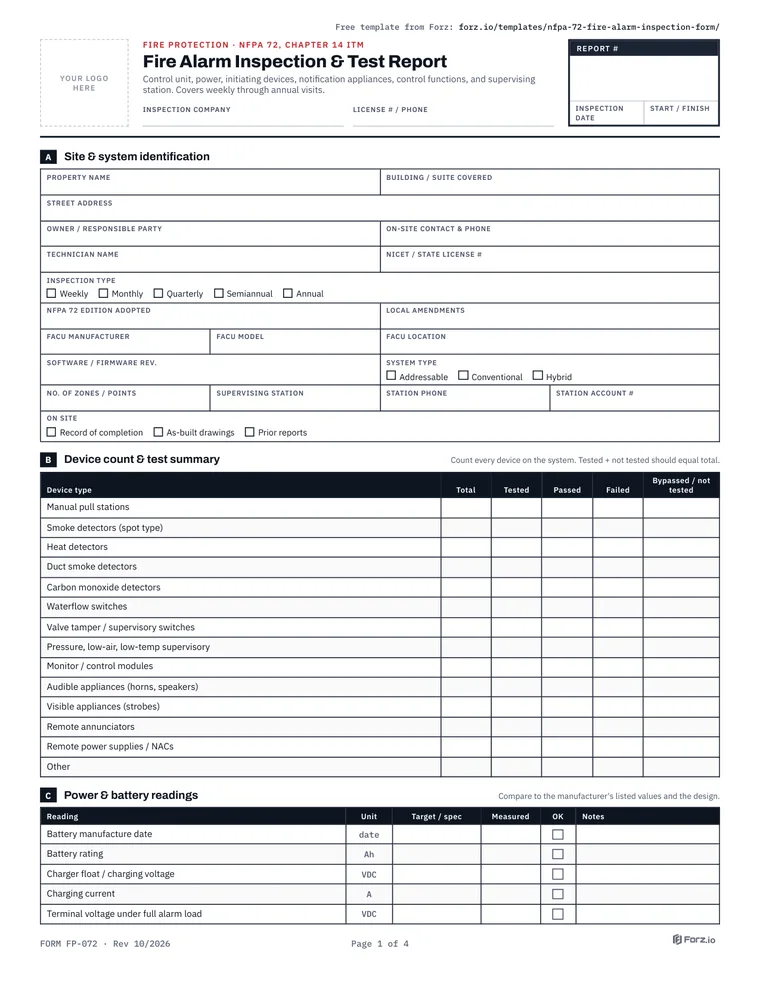
NFPA 72 Fire Alarm Inspection & Test Report
Fire Protection · Form
Company: ______________
Date: ______________
Technician: ______________
Site & System Identification
- Property name, street address, and building or suite covered ______________
- Building owner or responsible party and on-site contact ______________
- Inspection company, technician name, and NICET or state license number ______________
- Inspection date, start time, and finish time ______________
- Inspection type: weekly, monthly, quarterly, semiannual, or annual ______________
- Fire alarm control unit manufacturer, model, and physical location ______________
- Software or firmware revision of the control unit ______________
- System type: addressable, conventional, or hybrid; number of zones or points ______________
- Supervising (monitoring) station name, phone, and account number ______________
- Total device count: initiating devices, notification appliances, modules ______________
- NFPA 72 edition adopted and any local amendments in force ______________
- Record of completion, as-built drawings, and prior reports available on site ______________
Fire Alarm Control Unit
- Visual: panel reads normal, with no alarm, trouble, or supervisory conditions active ______________
- Visual: enclosure clean, undamaged, securely mounted, and door key present ______________
- Visual: field wiring landed on terminals, no loose or corroded connections ______________
- Visual: fuses, LEDs, and power-supply indicators in normal state ______________
- Functional: lamp/LED test illuminates all panel indicators ______________
- Functional: audible panel sounder operates on alarm and trouble ______________
- Functional: trouble signal annunciates when a circuit is opened (initiating, notification, and signaling line circuits) ______________
- Functional: ground-fault detection annunciates when a fault is introduced ______________
- Functional: each programmed alarm input produces the correct output sequence (cause and effect) ______________
- Disconnect, disable, or trouble conditions silence and restore correctly ______________
- Event history reviewed and panel time/date set to current ______________
- Walk test or single-point test of each addressable point logged at the panel ______________
Primary & Secondary Power, Batteries
- Visual: primary (AC) power connected, on a dedicated breaker, and breaker labeled ______________
- Functional: disconnect primary power and confirm the system transfers to secondary power and annunciates AC loss ______________
- Visual: batteries free of corrosion, leakage, swelling, or heat damage ______________
- Battery terminals clean, torqued, and interconnect cabling intact ______________
- Battery manufacture date recorded; sealed lead-acid commonly replaced within about 4 years (verify against the manufacturer's listed life and your adopted edition) ______________
- Charger test: float/charging voltage and current within the manufacturer's listed range ______________
- Load (capacity) test under full alarm load; terminal voltage holds above manufacturer end voltage ______________
- Replace battery if measured capacity is at or below 80 percent of rating ______________
- Standby duration confirmed adequate (commonly 24 hours standby plus 5 or 15 minutes in alarm, but verify per design) ______________
- Engine-driven generator or alternate power source tested where it serves as secondary supply ______________
Initiating Devices
- Visual: every device in place, undamaged, unobstructed, and within listed spacing ______________
- Manual pull stations: operate each station, confirm alarm at panel and correct address, then reset ______________
- Spot-type smoke detectors: functional test each with listed aerosol or test gas; confirm alarm and correct location label ______________
- Smoke detector sensitivity measured within listed range in the first year, then in alternate years (or per device self-test) ______________
- Heat detectors: test restorable spot types per manufacturer; confirm non-restorable types by mechanical or simulated means ______________
- Duct (air-sampling) smoke detectors: verify sampling airflow and alarm response; confirm fan shutdown interface where tied in ______________
- Carbon monoxide detectors: test per manufacturer where integrated into the fire alarm system ______________
- Waterflow switches: functional flow test at the adopted edition's interval (semiannual in the 2025 edition; NFPA 25 may call for quarterly on mechanical devices); confirm alarm within the retard period ______________
- Valve tamper / supervisory switches: operate and confirm supervisory signal at panel ______________
- Pressure, low-air, and low-temperature supervisory devices: operate and confirm signal ______________
- Addressable modules (monitor/control) report correct address and state ______________
- Device location labels and point list match the as-built record ______________
Notification Appliances
- Visual: horns, strobes, speakers, and combo units in place, undamaged, and correctly mounted ______________
- Visual: strobe lenses clean and candela markings match the approved plans ______________
- Functional: every audible appliance sounds during the alarm test ______________
- Functional: every visual appliance flashes during the alarm test ______________
- Sound pressure level measured and meets required dBA above ambient in occupiable areas ______________
- Strobe synchronization confirmed within field of view where required ______________
- Voice evacuation: messages intelligible (STI-PA or qualitative) at representative locations ______________
- Microphone, paging zones, and prerecorded message priority verified where installed ______________
- Visible appliances in sleeping areas meet required candela where applicable ______________
Emergency Control Functions & Interfaces
- Elevator Phase I recall: confirm primary and alternate recall on lobby/machine-room/hoistway detector activation ______________
- Elevator shunt trip and machine-room/hoistway smoke interface operate before recall, where provided ______________
- HVAC fan shutdown and smoke-control sequences operate on the designated alarm input ______________
- Smoke and fire dampers actuate to the correct position on alarm ______________
- Magnetic door holders release and rated doors close and latch ______________
- Electrically locked egress doors unlock on alarm where interfaced ______________
- Fire suppression releasing or pre-action solenoid signals verified (without discharge) per procedure ______________
- Each control relay confirmed to change state and return to normal after test ______________
Annunciators & Remote Equipment
- Remote annunciator display and LEDs mirror panel status during the test ______________
- Annunciator controls (acknowledge, silence, reset) operate and are access-restricted as designed ______________
- Graphic or LCD annunciator zone labels match field locations ______________
- Remote power supplies / NACs and addressable repeaters report normal and annunciate trouble ______________
- Printer or event recorder, where installed, logs events legibly ______________
Supervising Station & Communications
- Place system on test with the supervising station before transmitting signals ______________
- Transmit and confirm receipt of alarm, supervisory, and trouble signals for each type ______________
- Confirm both communication paths operate (e.g., IP plus cellular) on dual-path communicators ______________
- Fault each path individually and confirm the path-failure signal reaches the station within the listed time ______________
- Verify account number, premises address, and zone descriptions on file are correct ______________
- Confirm call list, emergency contacts, and runner/response instructions are current ______________
- Restore system from test and confirm the station logged normal restoration ______________
Results, Deficiencies & Sign-Off
- Overall result (system operates as intended): Pass / Fail ______________
- Deficiencies and impairments listed with device type, address, and location ______________
- Critical deficiencies (impaired detection, notification, or signaling) flagged and owner notified in writing ______________
- Corrective actions completed on site or recommended with priority ______________
- Devices left in bypass/disable noted with reason and planned restoration date ______________
- System restored to full automatic operation; all zones and the supervising station verified normal ______________
- Building owner or representative notified of results ______________
- Technician signature, printed name, license number, and date ______________
- Owner or authorized agent signature, printed name, and date ______________
- Next inspection and test due dates by frequency ______________
Customer / owner signature
Inspection, testing, and maintenance requirements come from the NFPA 72 inspection and testing chapter (recent editions commonly place visual inspection and functional test requirements in the Chapter 14 tables, but chapter, table, and section numbering varies by edition). Editions and locally adopted amendments vary; verify the applicable scope, test methods, and frequencies with your AHJ and the adopted edition. Frequencies shown here are commonly cited (for example semiannual waterflow testing in the 2025 edition, annual functional testing of most devices, and alternate-year smoke sensitivity checks) but can differ in your jurisdiction. This template is a starting point for your records, not the standard itself, and does not replace inspection or testing performed by qualified personnel.
The form mirrors the structure of the inspection, testing, and maintenance chapter that has been Chapter 14 since the 2010 edition, and the field list is compatible with the 2016, 2019, 2022, and 2025 editions. The rows are our own checklist wording, not text from the standard, and the applicable frequencies and test methods always come from the edition your authority having jurisdiction (AHJ) has adopted.
Searching for an “NFPA 72 inspection and testing form 2015”? There is no 2015 edition of NFPA 72: the editions around that date are 2013 and 2016. If your AHJ’s adoption references 2015, check whether it is pointing at the 2013 or 2016 edition of NFPA 72, or at a 2015 building or fire code that adopts one of them by reference.
How the 2016, 2019, 2022, and 2025 editions differ for inspection and testing
- 2016 edition. Keeps the layout introduced in the 2013 edition: the test method and test frequency for each component are read from one testing table (Table 14.4.3.2), and visual inspection frequencies stay in their own table (Table 14.3.1). This is the layout most inspection forms still follow.
- 2019 edition. NFPA 720 (carbon monoxide detection) was withdrawn and its requirements folded into NFPA 72, so CO detectors that are part of the fire alarm system now fall under the same Chapter 14 inspection and testing tables. That is why this form carries a carbon monoxide detector row under initiating devices.
- 2022 edition. Chapter 14 keeps the same structure with refinements to individual rows in the inspection and testing tables. If your contract or AHJ cites the 2022 edition, verify row-level frequencies and section numbers against that edition rather than an older form.
- 2025 edition (current, effective September 18, 2024). Chapter 14 keeps the same Table 14.3.1 and Table 14.4.3.2 layout. A new section 14.1.6 clarifies that inspection and testing personnel are not required to evaluate the design adequacy of an existing, previously approved system. It also sets semiannual inspection and testing for waterflow alarm and control valve supervisory devices. If your AHJ has adopted the 2025 edition, verify row-level frequencies and section numbers against it.
Whichever edition applies, record it in the site and system identification block on the first page so the report shows which requirements were used.
For how to run each test by device class, see our guide to NFPA 72 testing requirements. It covers test methods, pass criteria and records, not intervals.
Frequently asked questions
The form mirrors the structure of the inspection, testing, and maintenance chapter that has been Chapter 14 since the 2010 edition, and the field list is compatible with the 2016, 2019, 2022, and 2025 editions.
Is there a 2015 edition of NFPA 72?
There is no 2015 edition of NFPA 72. The editions around that date are 2013 and 2016.
This template is a starting point for your records, not the standard itself, and does not replace inspection or testing performed by qualified personnel.
The PDF is a print-ready version of the form on this page. The Excel workbook has the same sections and rows with a result column and a notes column per item, so you can fill it on a laptop, add rows for site-specific devices, and keep a copy per inspection. Both are free and need no sign-up.
If you would rather stop retyping the same form, the Forz mobile app runs this checklist on the phone: each device gets a Pass, Fail, or Bypass with photos, the technician signs on screen, the next due date is calculated from the frequency you set, and the customer downloads the PDF from their portal. See how fire protection companies run inspections in Forz or get a free demo.