Security & Fire Alarm System Inspection Form
Use this security and fire alarm system inspection form to document one site's full low-voltage life-safety and security stack in a single visit, covering intrusion (burglar) alarm, fire alarm devices, access control, and CCTV/video surveillance, along with standby power, tamper supervision, and the central station signal test. It groups checks the way a low-voltage technician works a building: head-end panels and controllers first, then field devices, then the monitoring path, finishing with a deficiency list and dual sign-off. Download the PDF for the clipboard, or run the same inspection in Forz: record Pass, Fail, or Bypass per device with photos and a digital signature, organize devices by system type with barcodes and locations, schedule each test on its own recurring frequency (intervals from daily through every 7 years), and let customers download the inspection PDF from the portal.
Fill this out on your phone with Forz → Get a free demo · see the mobile apps
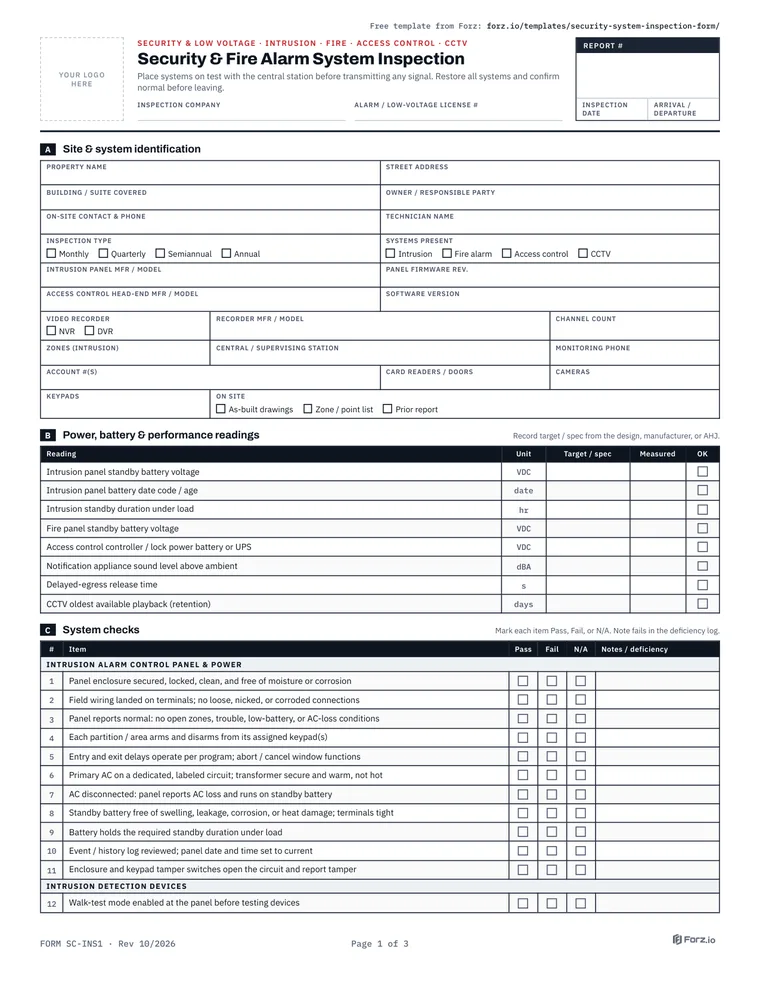
Security & Fire Alarm System Inspection Form
Security & Low Voltage · Form
Company: ______________
Date: ______________
Technician: ______________
Site & System Identification
- Property name, street address, and building or suite covered
- Building owner or responsible party and on-site contact name and phone
- Inspection company, technician name, and state alarm/low-voltage license number
- Inspection date, arrival time, and departure time
- Inspection type: monthly, quarterly, semiannual, or annual
- Systems present on site: intrusion, fire alarm, access control, CCTV/video surveillance
- Intrusion panel manufacturer, model, and firmware revision
- Access control head-end/controller manufacturer, model, and software version
- Video recorder type (NVR/DVR), manufacturer, model, and channel count
- Central/supervising station name, monitoring phone, and account number(s)
- Device counts: intrusion zones, card readers/doors, cameras, keypads
- As-built drawings, zone/point list, and prior inspection report available on site
Intrusion Alarm Control Panel & Power
- Visual: panel enclosure secured, locked, clean, and free of moisture or corrosion
- Visual: field wiring landed on terminals, no loose, nicked, or corroded connections
- Panel reports normal, with no open zones, trouble, low-battery, or AC-loss conditions
- Each programmed partition/area arms and disarms from its assigned keypad(s)
- Entry and exit delay timers operate per program; abort/cancel window functions
- Primary AC present on a dedicated, labeled circuit; transformer secure and warm-not-hot
- Disconnect AC: panel reports AC-loss and runs on standby battery
- Standby battery free of swelling, leakage, corrosion, or heat damage; terminals tight
- Battery date code recorded; sealed lead-acid typically replaced on a commonly cited 3-5 year cycle or when capacity falls below rating (verify per manufacturer and AHJ)
- Battery holds the required standby duration under load (commonly 4 or 24 hours per AHJ/UL, but verify by design)
- Event/history log reviewed; panel date and time set to current
- Enclosure and keypad tamper switches open the circuit and report a tamper signal
Intrusion Detection Devices
- Walk-test mode enabled at the panel before testing detection devices
- PIR/dual-tech motion detectors: walk the coverage pattern; confirm activation and correct zone/address
- Motion detector lenses clean, masking/anti-mask intact, mounting height and aim unchanged
- Door and window magnetic contacts: open each opening; confirm zone fault and gap within spec
- Glassbreak detectors: test with an acoustic simulator at rated range; confirm activation
- Shock/vibration and seismic sensors on safes/walls operate and report correct zone
- Hold-up/panic buttons and duress codes: operate each and confirm silent alarm to the station
- Photoelectric beams and perimeter devices align and trip at the protected line
- Environmental zones (water, low-temp, gas) where present operate and report
- Wireless devices report adequate signal strength and supervision; low-battery flags clear
- Every device label and zone description matches the as-built point list
Fire Alarm Devices (Where Tied to This System)
- Confirm scope: combination or integrated fire devices monitored here are tested per NFPA 72, not just the burglar panel
- Place fire alarm on test with the supervising station before initiating any fire signal
- Manual pull stations: operate each, confirm alarm and correct address, then reset
- Smoke detectors: functionally test with listed aerosol/test gas; confirm alarm and location label
- Heat detectors: test restorable spot types per manufacturer; confirm correct response
- Notification appliances: confirm horns/strobes activate; sound pressure meets required dBA above ambient
- Waterflow and valve tamper/supervisory switches operate and report where monitored
- Fire panel transfers to standby battery on AC loss and annunciates the trouble
- Restore fire alarm from test; confirm the station logged restoration to normal
Access Control System
- Controllers/door panels powered, communicating to the head-end, and reporting online
- Standby battery/UPS for controllers and locking power tested under AC loss
- Card/credential readers: present a valid credential at each reader; confirm grant and unlock
- Present an invalid/expired credential; confirm deny and that the event logs correctly
- Request-to-exit (REX) device releases the door and suppresses the forced-door alarm on egress
- Door position switch (DPS) reports open/closed accurately; door-held-open timer alarms
- Forced-door / door-forced-open event generates an alarm and logs at the head-end
- Electric strikes, maglocks, and electrified hardware lock and release fully; re-lock timing correct
- Fail-safe locks on egress doors release on power loss; fail-secure only where alternate egress exists
- Fire alarm / sprinkler interface drops locking power for immediate free egress on activation
- Delayed-egress doors: nuisance-delay release operates and door alarms (commonly 15s, up to 30s with AHJ approval)
- Door hardware, signage, and free-egress motion sensor unchanged from the approved design
CCTV / Video Surveillance
- Recorder (NVR/DVR) online, time/date synced, and reporting no drive or fan faults
- Hard-drive/RAID health checked; recording is active on all configured channels
- Retention verified: oldest available playback meets the required retention (commonly 30 days, but verify per policy)
- Each camera produces a live image on its assigned channel with no signal loss
- Image quality acceptable: in focus, correct exposure, color/white balance, no excessive noise
- Camera housings, lenses, and domes cleaned; no spider webs, condensation, or obstructions
- Field of view matches the documented coverage; no drift, sag, or repositioning
- Day/night and IR illuminator performance verified in low-light conditions
- Motion-record, scheduling, and any analytics/alerts trigger and notify as configured
- Remote/mobile viewing and recorded-clip export tested and functional
- PoE switches, midspans, and power supplies secure, ventilated, and not overloaded
Central Station & Communications
- Place the system(s) on test with the central station before transmitting any signals
- Transmit and confirm receipt of burglary, fire, hold-up/panic, and trouble signals
- Confirm both communication paths report (e.g., IP plus cellular) on dual-path communicators
- Fault each path individually; confirm the path-failure/comm-trouble signal reaches the station
- Open/close (arm/disarm) reporting confirmed at the station where supervised
- Account number, premises address, and zone/point descriptions on file verified correct
- Call list, emergency contacts, passcodes, and dispatch instructions confirmed current
- Restore all systems from test; confirm the station logged restoration to normal
Results, Deficiencies & Sign-Off
- Overall result by system (intrusion, fire, access control, CCTV): Pass / Fail
- Deficiencies listed with system, device type, zone/address, and location
- Life-safety deficiencies (impaired egress, fire detection, or signaling) flagged and owner notified in writing
- Corrective actions completed on site or recommended with priority and parts needed
- Devices or zones left bypassed/disabled noted with reason and planned restoration date
- All systems restored to normal; central station verified all accounts reporting normal
- Building owner or representative briefed on results and any open items
- Technician signature, printed name, license number, and date
- Owner or authorized agent signature, printed name, and date
- Next inspection due dates by system and frequency
Technician signature
Customer / owner signature
This form spans multiple standards: fire alarm checks follow NFPA 72, central-station monitoring relates to UL 827, and egress-locking and door-release behavior is governed by NFPA 101 and the building/fire code (commonly cited values such as the 15-second delayed-egress release, 30-second extended delay with approval, and 24-hour standby are examples, not universal requirements). Intrusion and CCTV practices vary by manufacturer, insurer, and Underwriters Laboratories listing. Editions and locally adopted amendments vary; verify the applicable scope, test methods, and frequencies with your AHJ and the adopted edition. This template is a starting point for your records, not the standard itself, and does not replace inspection or testing performed by qualified personnel.
Stop filling out paper forms
This same form runs in the Forz mobile app, where you also get photo documentation, digital signatures, automatic certificates, and recurring schedules so the next one books itself.
See how digital inspections work →Run inspections without the paperwork
Forz turns checklists like this one into mobile workflows. Techs complete them in the field with photos, and Forz files them automatically.