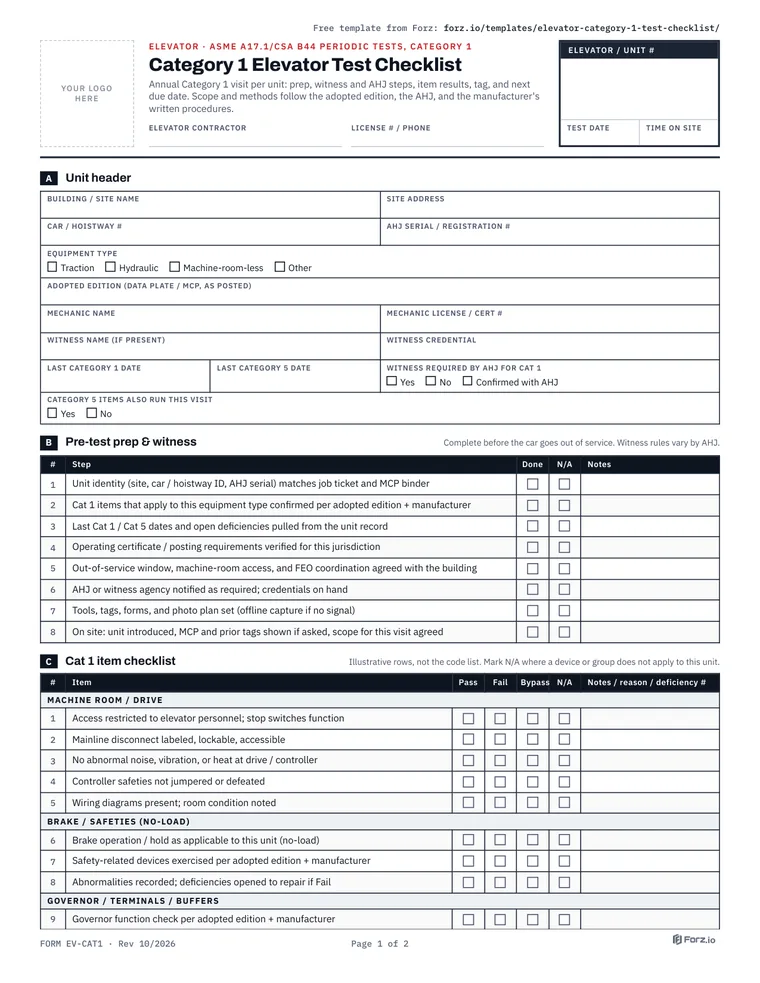
This template is for US and Canadian elevator contractors and qualified elevator personnel who run Cat 1 visits across multi-unit portfolios. It is a field form and a visit sequence, not a definition of Category 1 versus Category 5. For what each category covers and how jurisdictions differ, use our guide to ASME A17.1 Category 1 vs Category 5 testing. We build Forz, so the closing section says where the software fits for logging results per unit, and where a printed checklist is enough.
How to use this Cat 1 checklist (and what it is not)
Use it as the day-of / visit procedural checklist: pre-test prep → witness and AHJ steps → item checks by system → documentation and next due date. Walk the unit the way the crew walks the job. Mark Pass, Fail, or Bypass per row, add notes and photos where they help, and close with signatures.
Do not use it as a definition of Category 1 vs Category 5, as legal advice about your Maintenance Control Program (MCP), or as a substitute for the code edition your authority having jurisdiction (AHJ) has adopted. Those definitions stay on the ASME testing categories post. Routine MCP maintenance walks (monthly, quarterly, and similar) stay on the elevator maintenance checklist. This page is the annual Category 1 test pass.
Disclaimer: Your AHJ, the adopted A17.1/B44 edition (and local amendments), and the manufacturer’s written procedures govern scope, methods, witnessing, tags, and records. This template is a starting point for qualified elevator personnel. It is not the standard, and it is not a DIY guide for building owners.
Pre-test prep
Work through these before you take the car out of service. No costs or lead times are implied; every jurisdiction schedules differently.
- Confirm unit identity. Site, car or hoistway ID, and AHJ serial or registration must match the job ticket and the MCP binder for that unit.
- Confirm which Cat 1 items apply to this equipment type (traction, hydraulic, machine-room-less, and so on) per the adopted edition and the manufacturer’s written procedures. The groups below are illustrative starting points, not “the code list.”
- Pull last Cat 1 and Cat 5 dates and any open deficiencies from the unit record (software or binder) so you are not discovering last year’s fails on site.
- Verify operating certificate / posting requirements for the jurisdiction. Practice varies; confirm locally.
- Schedule the window with the building. Tenant impact is usually lighter than a Cat 5 visit, but you still need machine-room access, FEO coordination where that is part of this visit, and a clear out-of-service window.
- Line up a witness or inspector if the AHJ requires one for Cat 1. Some jurisdictions allow licensed personnel to perform Cat 1 without a separate witness; others do not. Confirm before you book.
- Set tools, tags, forms, and a photo plan. If the machine room has no signal, plan for offline mobile capture.
- If Cat 5 is also due this year, weight and logistics are a different prep path. This checklist does not cover Cat 5 procedure. Keep the annual Cat 1 obligation on the calendar either way (see the overlap note under Witness and AHJ).
Witness and AHJ steps
Who performs the test and who witnesses it are separate questions, and both are AHJ-dependent. Qualified elevator personnel typically perform Cat 1. An inspector, Qualified Elevator Inspector (QEI), or third-party witness may or may not need to be present. Do not assume a universal rule.
Booking and notification: notify the AHJ or witness agency the way your jurisdiction requires, agree a date window with the building, and bring the credentials the inspector expects to see. Lead times and attendance charges depend on your local practice, so this template leaves them out.
On site: introduce the unit, show the MCP and prior tags if asked, and agree the scope for this visit before you start. If FEO Phase I/II is part of this visit under the adopted edition and AHJ practice, say so up front, and don’t suggest that every Cat 1 includes a full FEO run.
Overlap years: when Cat 5 is also due, Cat 1 generally still is. For how overlap years and filing examples work across jurisdictions, see the FAQ and variance section on the ASME Category 1 vs Category 5 guide. This checklist does not re-argue local examples.
Filing vs on-site retention: some AHJs keep Cat 1 records on site with the unit; others require filing. Verify locally. Never treat a universal filing deadline as part of this form.
In Forz (elevator service management software), Category 1 is its own inspection type on the unit with an annual frequency, and Forz calculates the next due date when the result is recorded. Note the witness requirement on the unit or the job.
Cat 1 item checklist (field form)
Print the checklist above or run it as an inspection form, marking Pass, Fail, or Bypass per row. Rows are illustrative starting points for qualified personnel. Editions, amendments, and manufacturer procedures differ. Do not treat the checklist as the code list. Leave acceptance criteria blank; fill what you measure or observe on this visit.
Which groups apply by equipment type:
- Unit header: all equipment types. Confirm the adopted edition with the AHJ; do not assume it.
- Machine room / drive: traction and hydraulic with a machine room; adapt for MRL machinery spaces; mark N/A where no separate room exists.
- Brake / safeties (no-load): traction (typical); hydraulic / MRL as applicable to the unit’s safety devices. Exercise devices without rated load where that is the Cat 1 method for this unit. This checklist gives no hold or acceptance values.
- Governor / terminals / buffers: traction and other types with governor / terminal / buffer equipment; mark N/A where the device is not installed. Use the same no-load approach as the brake / safeties group.
- Doors / interlocks / FEO: all passenger/freight configurations with hoistway doors. FEO Phase I/II only as required for this visit (AHJ / adopted edition). Not every Cat 1 includes a full FEO run; otherwise mark Bypass with a reason.
- Emergency comms / car operation: all units with car emergency systems as equipped.
- Hydraulic-only block: hydraulic units only. Traction / MRL without a hydraulic power unit: mark N/A and skip. See the hydraulic section below for relief-valve, pressure and buried-piping notes. Its measurement fields are left blank on purpose.
- Sign-off: all visits. Open a repair job for each deficiency, photograph the test tag, and attach the customer PDF if you use a portal.
Documentation fields (what to leave on the unit)
Documentation is part of a complete Cat 1 visit. An untagged or unrecorded unit often reads as untested to an inspector. Our ASME testing categories guide emphasizes the same practice point.
Capture at least:
- Unit identifiers and jurisdiction registration
- Test type: Category 1 (annual), and whether any overlapping Cat 5 items were also run on this visit
- Date/time; mechanic name and license or certification; witness name and credential if present
- Result per checklist item (Pass / Fail / Bypass) plus a deficiency list
- Photos of tags, gauges where taken, FEO panel, and nameplates as needed
- Test tag completed and displayed per AHJ practice
- Record retained with the unit MCP / maintenance records; customer PDF if you use a portal
- Next Cat 1 due date (annual clock), set in software or on the binder card
In short: complete and display the test tag; retain records with the unit MCP per the adopted edition. Subsection numbers drift by edition, so for how MCP records and category testing fit together, see the ASME guide.
Hydraulic elevators: pressure / relief-valve note
Hydraulic Cat 1 scope often includes relief-valve setting and system pressure checks among other items. That practice is commonly cited under recent A17.1/B44 editions adopted by many AHJs. Confirm the adopted edition and amendments before you treat any item as mandatory on this visit.
Record as-found and as-left as blank fields only. Do not copy sample pressures from another job or from a blog post.
| Measurement | As-found | As-left | Gauge / notes |
|---|---|---|---|
| Relief-valve setting | ________ | ________ | |
| System pressure (as applicable) | ________ | ________ |
Extra examination rules for cylinders or buried piping that cannot be visually inspected may apply to some installations in some jurisdictions. Verify with the AHJ. Don’t copy another state’s example into this form. Category context stays on the ASME Cat 1 vs Cat 5 post.
Safety: qualified elevator personnel only. Follow the manufacturer’s written procedure for gauge placement, lockout, and restoration before returning the car to service.
After the test: deficiencies, tags, and next due date
Close the visit the same day whenever you can:
- Fail or Bypass with a real deficiency → written notice to the owner or manager, and a repair job on the same unit.
- Update the MCP / digital unit history so the binder and the software match.
- Complete and display the test tag; retain the record with the unit MCP per the adopted edition and AHJ practice.
- Set the next Cat 1 due date. Leave the Cat 5 clock alone unless the AHJ says otherwise.
When Forz fits (and when a printout is enough)
Forz is field service management software for elevator contractors. Here is how Forz handles a Cat 1 visit:
- Each elevator is a device record, so CAT1 / CAT5 scheduling runs per unit. A unit can carry multiple inspection types on independent frequencies (annual Cat 1 and five-year Cat 5 on the same car). Forz calculates the next due date when a result is recorded.
- Crews record Pass / Fail / Bypass with photos offline. The iOS and Android apps keep working in machine rooms and pits, and results and photos sync when the device reconnects.
- Dated inspection results attach to the unit, so records stay MCP-aligned, and customers can download PDFs from the portal when an inspector or insurer asks.
- Forz costs $50 per user per month billed annually, or $60 month-to-month, with a 10-user minimum and every core module included. Details are on our pricing page.
For platform comparisons, see best elevator service software.
Forz fits shops that want Cat 1 results on the same unit history as maintenance visits, callbacks, and Cat 5 dates, without rebuilding the paper trail at audit time.
A printed checklist is enough if you only need a one-off paper form and do not keep digital unit history. Use this page either way.
FAQ
Is this the same as the monthly MCP maintenance checklist?
No. The elevator maintenance checklist is the recurring MCP visit walk (machine room, hoistway, pit, doors, and so on). This Cat 1 template is the annual Category 1 test pass: prep, witness, item results, tags, and next due date. Use both; they serve different clocks.
Do I need a witness for every Cat 1?
It depends on the AHJ. Some jurisdictions allow licensed elevator personnel to perform Cat 1 without a separate witness; others require an inspector or third-party witness. Confirm before you schedule. There is no universal yes or no on this page.
Does Cat 1 include the relief-valve test on traction units?
Generally no. Relief-valve and system-pressure checks are a hydraulic concern. Confirm equipment type, the adopted edition, and manufacturer procedures. Traction rows in the hydraulic-only block should be marked N/A.
Where are Category 1 and Category 5 defined?
On our ASME A17.1 Category 1 vs Category 5 testing guide. This template does not redefine them.