A main drain test is a quick check of the water supply to a sprinkler system: you read the supply gauge at rest, open the main drain fully, read it again while water flows, and compare the numbers with earlier tests. A 10 percent reduction in full-flow pressure from the acceptance test or earlier tests is the point where NFPA 25 calls for finding the cause and correcting it if necessary.
The test is easy. The part that goes wrong is the comparison. A number with nothing to compare it to tells the owner very little.
Summary reference, not the standard. Steps come from the sources below and from trade practice. The criteria are NFPA 25’s (Standard for the Inspection, Testing, and Maintenance of Water-Based Fire Protection Systems). Section numbers move between editions. The edition your AHJ adopted, plus local amendments, controls. NFPA offers free read-only access to NFPA 25, which may ask you to sign in.
How often it’s due
The short version: annually, and quarterly for at least one system downstream where the sole water supply comes through a backflow preventer or pressure-reducing valve. The NFPA blog’s sprinkler maintenance summary lists it that way, and so does our NFPA 25 and NFPA 72 frequency chart. Intervals live on the chart. This page is about method and records.
One location point trips up crews:
- NFPA 25 ties the test to each water supply lead-in. Where one lead-in feeds a header or manifold serving several systems, the standard permits a single main drain test. Wording has changed between editions, so check the one your AHJ adopted.
Write the test locations into the building record once, so next year’s tech tests the same points.
Before you open the valve
Most of the trouble with a main drain test is water going somewhere it shouldn’t. Check these first:
- Discharge path. Where does the drain go? Outside to grade, to a floor drain, to a hose? HFM notes that any inability to safely discharge water should be written down, including use of a fire hose, because it can shorten the test and skew the reading. Confirm a floor drain can take the full flow, and in freezing weather watch for ice where the water lands.
- Monitoring company. Opening the main drain can trip a waterflow signal or local bell on some systems. Put the system on test with the monitoring company first, note the time, and tell the building contact before you open the valve.
- Building notice. Tell the owner’s rep where water will run and for how long you expect to flow.
- Gauge. The supply-side gauge is the one you read. If it looks wrong, note it before you start.
- Valves and pump. Walk the control valves and confirm each is fully open and in its normal position. Note whether a fire pump is installed and whether it is in its normal state, because a pump that starts during the test raises the residual.
- Last results. Have the acceptance test results and the last few readings in hand. NFSA notes the owner is expected to keep the original acceptance results for the life of the system; check the records section of the adopted edition.
Running the test
The U.S. Fire Administration’s training note on main drain tests lays out the basic sequence, and NFSA and HFM describe the same steps.
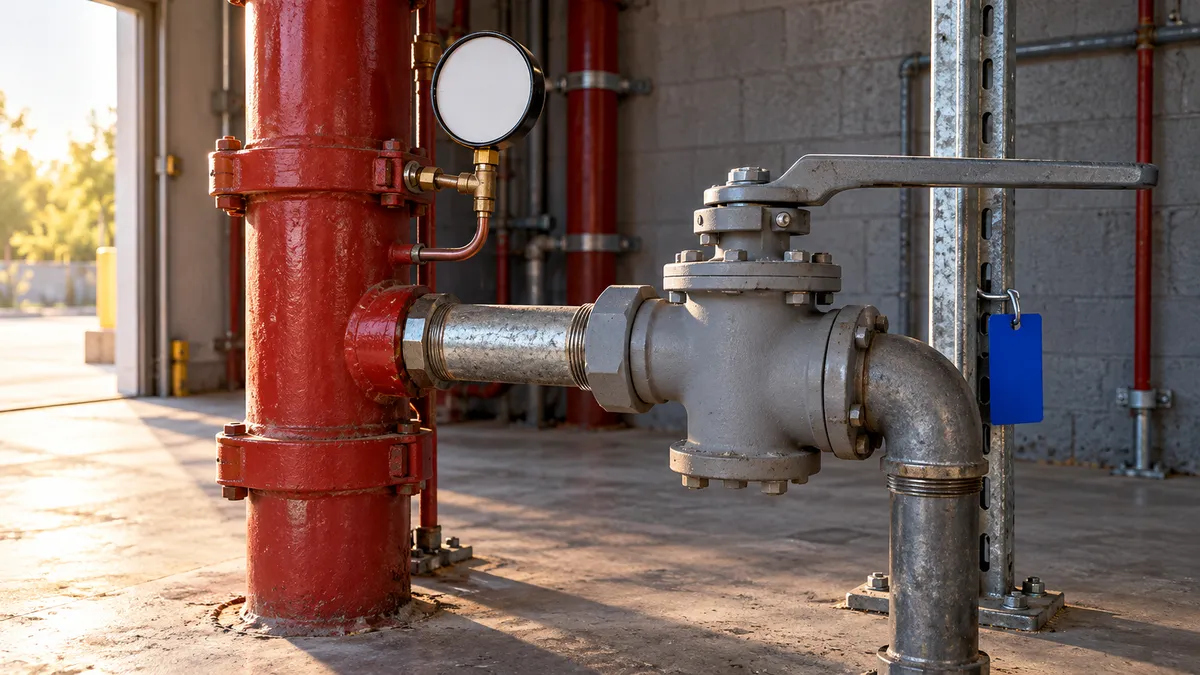
- Read and record the static pressure on the supply side of the alarm or dry pipe valve.
- Slowly open the main drain fully. Let the water run until it’s clear and the gauge settles.
- Read and record the residual pressure once the needle stabilizes.
- Slowly close the main drain until it is fully shut.
- Record the return pressure and how long it took to come back to the starting static. A slow return is worth noting.
- Confirm the drain is fully closed and not weeping, take the system off test with the monitoring company, and confirm any signals cleared.
Open and close slowly. Closing the valve quickly in particular can cause a pressure surge (water hammer) in the system and the supply main.
Comparing the result
The main drain provision compares the result with the original acceptance test or previous tests. Compare against both: checking only last year can hide a slow decline.
Here’s an illustrative example (made-up numbers to show the math, not code values):
| Test | Static (psi) | Residual (psi) | Residual vs acceptance |
|---|---|---|---|
| Acceptance | 80 | 62 | baseline |
| Two years ago | 79 | 60 | 3% lower |
| Last year | 79 | 58 | 6% lower |
| This year | 78 | 55 | 11% lower |
Compared with last year alone, this year’s residual is down about 5%, which looks fine. Compared with the acceptance test, it’s down about 11%, which crosses the 10% line. That’s why the acceptance number has to live in the record next to every new test.
What a drop can mean
USFA’s note says a dramatic drop from previous tests suggests a partially closed valve or another obstruction in the supply main. NFSA lists partially closed valves or blockages in the piping among the things the test can reveal. Other things that change the reading and should be written on the report:
- A control valve that isn’t fully open (check and record valve positions).
- A change on the water purveyor’s side, such as main work or pressure changes.
- A different discharge setup than last time, like a hose instead of a direct outlet.
- A gauge that has been replaced or reads oddly.
- A fire pump that started during the test, or a time of day when the utility’s pressure is normally higher or lower.
The report should say what was checked. “Drop noted” on its own helps nobody. The owner needs to know whether the next step is opening a valve, calling the water utility, or scheduling an obstruction investigation. If the cause turns out to be a closed or partly closed control valve, it can be an impairment under your adopted edition: follow your impairment procedure and notify the owner right away.
What to record every time
| Field | Why it matters |
|---|---|
| Building, system and test location | So next year’s test is at the same point |
| Supply type (backflow/PRV or not) | Decides annual vs quarterly |
| Static, residual and return pressure | The test itself |
| Time for pressure to return | HFM lists it among the readings to consider |
| Discharge method | A hose or restricted outlet affects the result |
| Acceptance and prior residuals | Required for the comparison |
| Percent change vs acceptance and vs last test | Shows whether the 10% line was crossed |
| Valve positions checked | Rules out the most common cause |
| Monitoring company on/off test times | Proves signals were handled |
| Tech name, signature, date | Accountability |
| Date, time of day, and whether a fire pump was running | Utility pressure changes through the day, and a running pump raises the residual |
| Gauge used | So next year’s reading comes from the same gauge |
Our NFPA 25 sprinkler inspection checklist includes the main drain line alongside the rest of the visit.
Keeping the history usable
What makes the test useful is having five years of readings and the acceptance number in one place when the tech is standing at the riser.
Fire inspection software can keep each system’s readings attached to the building, so the tech sees prior results on site and the office sees the trend. In Forz, Sprinkler is a default system type with its own custom fields for inspection data, techs record results offline, and customers download the PDF report from their portal. Pricing is on the pricing page: $50 per user per month billed annually, $60 month-to-month, 10-user minimum.
Forz is built for fire protection contractors who run these tests across many buildings. If you only test a few buildings a year, a spreadsheet with the acceptance number in the first row will do the job.
Keep each result for comparison. Our guide to NFPA 25 record retention covers how long.
FAQ
What is the main drain test for?
To see whether the water supply has changed since the system was accepted. HFM quotes the standard’s purpose as “to determine whether there has been a change in the condition of the water supply.”
Is a 10% drop a failure?
NFPA 25 calls for an investigation into the cause and correction where necessary. It’s a trigger to find out why, not an automatic impairment. If the investigation finds a closed or partly closed control valve, it can be an impairment under your adopted edition and your AHJ’s rules, so follow your impairment procedure.
Do I compare with last year or the acceptance test?
The standard points to the acceptance test or previous tests. Compare against both, because a slow decline hides when you only compare year to year.
Do I test every riser?
Not necessarily. The test is tied to each water supply lead-in, and where one lead-in feeds a header or manifold serving several systems, a single test is permitted. Check the edition your AHJ uses.
Sources
- NFPA 25, free read-only access (may ask you to sign in)
- NFPA blog, “NFPA 25 and Properly Maintaining a Sprinkler System” (Aug 26, 2024)
- NFSA, main drain tests explainer (Aug 8, 2022)
- HFM Magazine, “Complying with main drain testing code”
- U.S. Fire Administration / NFA Coffee Break Training No. 2006-15, Sprinkler Main Drain Tests