Inspectors argue about how a device was tested more often than when. An annual visit that used the wrong method, or never proved smoke entry, still fails when the AHJ or the next contractor reviews the report.
This guide covers test methods, pass criteria, and records for commercial fire alarm systems. For how often each test is due, use our NFPA 72 frequency chart. Intervals stay on that page.
Summary reference, not the standard. Methods are paraphrased from the NFPA 72 ITM chapter in recent editions, in the edition your AHJ has adopted (including local amendments). Manufacturer instructions and your AHJ control.
Written for fire alarm inspection/testing contractors and service managers at commercial shops. One- and two-family dwellings and household smoke alarms are out of scope.
Where NFPA 72 testing requirements live (and which edition applies)
In recent editions, the inspection, testing, and maintenance (ITM) chapter is Chapter 14:
- 14.2 General requirements for personnel, impairments, and how testing is conducted
- 14.3 Inspection: visual checks, commonly summarized in Table 14.3.1
- 14.4 Testing: component, initial acceptance, periodic frequency, and method, commonly summarized in Table 14.4.3.2
- 14.5 Maintenance
- 14.6 Records
Documentation forms and the record of completion sit in Chapter 7 (Documentation) in recent editions.
Three test types to keep separate:
- Initial acceptance: when the system is first installed or substantially completed.
- Reacceptance: after changes that affect the system (see the reacceptance provisions in Chapter 14 in recent editions).
- Periodic: the recurring ITM this post is about, with notes where acceptance methods differ.
Edition differences are covered on our NFPA 72 fire alarm inspection form under “How the 2016, 2019, 2022, and 2025 editions differ.” CO detectors that are part of the fire alarm system fall under the same Chapter 14 tables in recent editions (NFPA 720 was folded into NFPA 72).
See the NFPA 72 document page on nfpa.org. Always verify against the edition your AHJ has adopted.
Before you test: notifications, impairments, and interfaces
Put the system on test with the supervising station before any signal goes out, and confirm it is restored at the end. Skipping either step creates false dispatches or leaves the premises unprotected on paper.
Notify the owner/occupants and, where the adopted code requires it, the AHJ. Recent editions handle impairments and out-of-service conditions in the general section of Chapter 14.
Identify the emergency control functions your test will trip (elevator recall, HVAC/smoke control, door release, releasing panels) and coordinate the trades: elevator mechanic present for recall, suppression releasing circuits isolated per procedure. No discharge.
Have the as-built device list or point list and the previous report on hand. Missing devices, painted detectors, and wrong addresses are findings, not surprises.
Test methods by device class
These are paraphrases of the “method” column commonly associated with Table 14.4.3.2 in recent editions, not quotations. For when each item is due, see the frequency chart; this section does not restate intervals.
Control unit and transponders
Verify alarm, supervisory, and trouble functions at the control unit. Confirm that an open or ground fault on initiating, notification, and signaling line circuits annunciates trouble. Check lamps/indicators and the panel sounder. Walk cause-and-effect programming where the system uses it, so the programmed inputs produce the expected outputs. See the “Fire Alarm Control Unit” block on the NFPA 72 form template for a field checklist structure.
Primary and secondary power, batteries
Confirm transfer to secondary power when primary power is removed, and that AC-loss trouble annunciates. Run charger and discharge/load tests by battery type (for example VRLA versus other chemistries), following the manufacturer’s listed procedure. Replacement criteria come from the applicable table row and the manufacturer. This post gives no capacity percentages or standby-hour numbers; use the adopted edition and the manufacturer’s data. For battery intervals, use the chart.
Spot smoke detectors (functional)
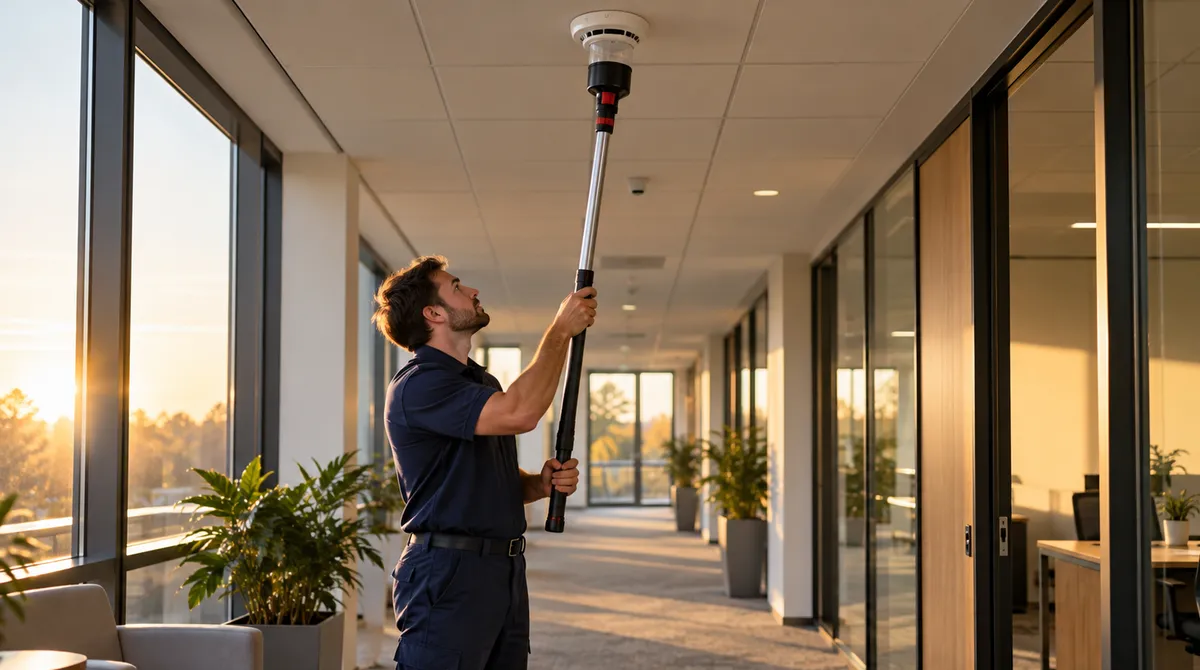
Prove smoke entry into the chamber with smoke or a listed aerosol acceptable to the manufacturer, or another manufacturer-listed method that proves entry. A magnet or test switch alone does not prove smoke entry. Confirm alarm at the panel with the correct address/label, then restore.
Smoke detector sensitivity
Sensitivity testing is separate from the functional (smoke-entry) test. Accepted method types in recent editions commonly include: a calibrated test method, the manufacturer’s calibrated instrument, listed control equipment, a control-unit out-of-range signal, or another AHJ-approved calibrated method. For interval and extension rules, see the frequencies post section on smoke detector sensitivity testing. You cannot defend an extended sensitivity interval without consecutive in-range records.
Duct smoke detectors
Verify airflow/sampling per the manufacturer, plus alarm response. Confirm the fan-shutdown (or other interfaced) function if the detector is tied into HVAC control.
Heat detectors
Restorable spot types: apply a heat source per the manufacturer without damaging the device. Non-restorable types: use a mechanical or electrical test method, not destructive heat. Line-type heat detection: follow the listing and manufacturer instructions.
Where the adopted edition uses a rotating sample for restorable heat detectors, document which devices were exercised on this visit so the rotation stays defensible. See the FAQ on sampling vs all devices.
Manual pull stations
Operate the mechanism. Confirm the alarm at the panel with the correct address. Reset the station and the system.
Waterflow and supervisory devices
Coordinate with the sprinkler (NFPA 25) contractor. Flow from the inspector’s test connection and confirm alarm within the device’s retard setting. Operate valve tamper devices and confirm the supervisory signal per the listing. As our frequencies post notes, waterflow devices sit in both standards (NFPA 25 and NFPA 72). For sprinkler-side checklists, see the NFPA 25 sprinkler inspection checklist and the waterflow rows on the frequencies post.
CO detectors (when part of the fire alarm system)
Test per the manufacturer and the Chapter 14 tables in recent editions. Out of scope here: standalone CO alarms that are not part of the fire alarm system.
Notification appliances
Confirm every audible appliance sounds and every visible appliance flashes during the alarm test. Confirm synchronization where required.
Sound-pressure measurement: Sound-pressure (dBA) surveys are commonly part of initial acceptance and reacceptance when notification is new or changed. For periodic tests, recent editions typically emphasize verifying that each audible and visible appliance operates (sounds / flashes; sync where required). Whether a full dBA re-survey is due on a periodic visit depends on the edition your AHJ has adopted, local amendments, and whether the notification arrangement changed. Confirm before treating a meter walk as routine periodic work. This post does not invent a dBA threshold or a periodic survey interval.
Voice / emergency communications systems
Verify message delivery and microphone / paging priority where installed. Intelligibility verification approach differs between acceptance and periodic testing in some editions. Confirm the adopted edition and AHJ expectations before scoping the visit.
Emergency control function interfaces
Verify each interfaced function operates, or that the control relay changes state and restores: elevator recall (primary and alternate), HVAC shutdown, dampers, door holders, locked egress unlock, and suppression releasing signals without discharge. Elevator recall work often needs the elevator mechanic on site. Schedule that trade; don’t skip the interface. (Elevator contractors: see elevator services.)
Supervising station transmission
Transmit and confirm receipt of alarm, supervisory, and trouble signals. On dual-path communicators, fault each path individually and confirm the path-failure signal is received at the station. Restore the system from test and confirm the station logged normal restoration.
What counts as a pass (acceptance criteria)
A pass is not “the horn made noise.” For each device or function:
- The right signal type (alarm vs supervisory vs trouble).
- The right address or label at the panel (and station, where applicable).
- The signal is received where it should be.
- The system is restored to normal, with no orphan bypasses or open troubles left behind.
Sensitivity outside the listed range → clean/recalibrate, adjust if field-adjustable, or replace, then re-verify before closing.
Deficiency vs impairment: Record each clearly. Deficiencies need corrective action. Impairments take protection out of service and commonly trigger owner notice in writing and, under the adopted code, mitigation such as AHJ notice or a fire watch.
Optional color-coded tagging appears as an informative annex in recent editions; adoption varies by jurisdiction.
Records: what to write down for every device
A useful per-device record is a table of fields, not a reproduction of any NFPA form. These are the columns:
| Device ID / address | Location | Device type | Method used | Result (Pass/Fail/Bypass) | Sensitivity reading or method (if tested) | Deficiency # | Tech / license |
|---|
Also record, at the report level: the edition and amendments applied, test date, technician qualifications/license, supervising-station confirmation (on-test and restored), and any devices left bypassed with planned restoration.
Retention: Recent editions address retention in 14.6. In general, standards require keeping ITM records long enough to compare against the next test of the same type; a commonly cited practice is at least one year after the next inspection, with longer retention for infrequent tests; many contractors keep the full life-of-system history.
Capture the same fields on our NFPA 72 inspection and test form.
Common failures found during fire alarm testing
These are practice notes from the field, not statistics:
- Functional “smoke” tests done with a magnet or test button only, with no proof of smoke entry into the chamber.
- Devices on the as-built list missing, painted, bagged, or obstructed after renovations.
- Waterflow tested without the sprinkler contractor, so retard and alarm timing go unverified.
- Batteries with no manufacture date or load-test record on file.
- Supervising station never placed on test (false dispatch), or never restored after the test.
- Interfaces skipped because the elevator mechanic or HVAC tech wasn’t scheduled.
- Extended sensitivity intervals claimed without consecutive in-range records.
Worked example: one floor, device by device
Illustrative only: not a real customer, and no intervals are stated as requirements.
A three-floor office building. Floor 2 sample during a periodic test:
| Device | Method used | Result | Follow-up |
|---|---|---|---|
| Smoke FA-SD-201 (Suite 201) | Listed aerosol; smoke entry confirmed; correct address at panel | Pass | None |
| Smoke FA-SD-205 (Corridor) | Aerosol attempted; chamber capped after painting; no entry | Fail | Deficiency logged → repair estimate for clean/replace |
| Duct FA-DD-2 (AHU-2) | Airflow verified per manufacturer; alarm response OK; fan shutdown confirmed | Pass | None |
| Heat FA-HD-210 (Storage) | Restorable spot; heat source per manufacturer | Pass | None |
| Pull FA-PU-2E (East stair) | Mechanism operated; address confirmed; reset | Pass | None |
| Horn/strobe FA-HS-2N | Audible + visual during alarm; sync OK in field of view | Pass | None |
| Horn/strobe FA-HS-2W | Bypassed for tenant meeting during test window | Bypass | Reason noted; restoration scheduled same day |
| Waterflow (Floor 2 zone) | Inspector’s test with sprinkler contractor; alarm within retard | Pass | Coordinated NFPA 25 ∩ 72 |
One Fail becomes a deficiency and a repair quote. One Bypass is documented with planned restoration. The report shows method, result, and follow-up, not a vague “Floor 2 tested OK.”
Running device-level NFPA 72 testing in Forz
From our fire inspection software page and the frequencies post:
- Fire Alarm system type; barcode every device.
- Separate inspection types per device (functional vs sensitivity vs visual), each with its own due date.
- Pass / Fail / Bypass with photo, offline.
- Fail → estimate → customer accepts in portal → job (customer, site, system, line items).
- Customers download the PDF from the portal; branded custom documents with merge fields for letterhead.
- Tech skills and certificates gate scheduling suggestions.
$50/user/month annual or $60 month-to-month, 10-user minimum, every core module included. See pricing or book a demo. Also: fire protection, best fire protection software, ServiceTrade alternative.
FAQ
Does NFPA 72 require testing every device every year?
For how to test, use the device-class methods above. For when each test is due, use the NFPA 72 frequency chart. This post does not restate intervals. When a device class is due for periodic testing, recent editions generally require testing the listed devices of that class, not a building-wide statistical sample. A well-known method exception is restorable heat detectors, which commonly use a rotating sample per initiating-device circuit so different detectors are exercised over time until all have been covered (confirm the exact sample rules in the adopted edition). Non-restorable heat detectors follow a separate sample/lab path after years in service (again, edition + AHJ). Initial acceptance is typically a full test of installed devices and functions. Automatic/listed remote testing provisions, where present and accepted by the AHJ, can change how often manual tests are needed; do not assume they apply. For when each row is due, use the frequency chart. This answer does not restate intervals.
Can a magnet test a smoke detector?
A magnet or test switch can exercise electronics, but it does not by itself prove smoke entry into the chamber. Use smoke or a listed aerosol (or another manufacturer-listed method that proves entry), unless your adopted edition and manufacturer instructions say otherwise.
Who is allowed to test a fire alarm system?
Qualified personnel per the general section of Chapter 14 in recent editions, plus state and local licensing rules. NICET credentials are often referenced in the industry but are not a universal substitute for the adopted code and license law where you operate.
What’s the difference between inspection and testing in NFPA 72?
In recent editions, inspection is primarily visual (commonly Table 14.3.1) and testing is functional verification of operation (commonly Table 14.4.3.2). Both matter; a visual-only visit is not a functional test.