A maintenance control program (MCP) is the written, per-unit plan that says which maintenance tasks, examinations and tests get done on an elevator and how often, plus the records that prove they were done. Under ASME A17.1 the firm maintaining the equipment provides it, and elevator personnel have to be able to view it on site. The owner generally stays responsible for the equipment overall, and owner duties vary by jurisdiction.
A common problem with MCPs is a generic binder that doesn’t match the unit, or a completion record missing the date, the task or the interval. This guide walks through what an MCP contains, what the records need to show, where they have to be, and a routine that keeps them current across a route.
For the difference between Category 1 and Category 5 tests, see our ASME A17.1 Cat 1 vs Cat 5 guide. This post stays on the program and the paperwork.
What the MCP has to cover, in short
The wording below is paraphrased from ASME A17.1 Section 8.6.1 as reproduced in Seattle’s amended building code, and from state and provincial agency publications. Section numbers shift between editions, and your jurisdiction may amend them, so check the edition your AHJ enforces.
- One program per unit. The MCP is written for each unit by the person or firm maintaining it, and it has to be viewable on site by elevator personnel from acceptance or installation onward (Seattle Building Code on UpCodes, quoting A17.1 8.6.1).
- Tasks and intervals. It specifies examinations, tests, cleaning, lubrication and adjustments at regular intervals, and lists each code-required task with the requirement it comes from. When the code’s maintenance section changes a task, the MCP is supposed to be updated (same source).
- Intervals with a reason. The scheduled intervals are based on factors such as equipment age, condition and wear, design, usage, environment, and the manufacturer’s recommendations (same source). A copied interval sheet from another building doesn’t meet that test.
- Pointers to documents and records. The MCP references the on-site equipment documentation and the maintenance records that show each task was completed (same source).
The on-site documentation that sits beside it
The same part of the code lists documents that have to be kept on site for each unit, in the machine room, control room or similar space (UpCodes). In plain terms:
- Up-to-date wiring diagrams for the electrical protective devices and critical operating circuits.
- Written procedures for inspections and tests that aren’t described in ASME A17.2, and for maintenance, repairs and adjustments where the code says a written procedure is required (checkout procedures are a common example).
- Unique procedures from the manufacturer or installer for things like SIL-rated devices or equipment installed under alternative arrangements.
Wiring diagrams often go stale after a controller change. If the mod crew left the old prints in the cabinet, the “up-to-date” requirement isn’t met even though there’s paper on site.
What the maintenance records have to show
The records are what an inspector reads first. Nova Scotia’s 2026 safety directive lists the fields its amended code expects in MCP records, which makes a useful starting point in most jurisdictions (Nova Scotia Safety Directive 00012):
| Field | What to write | Common miss |
|---|---|---|
| Site name and address | The building, not the customer’s billing address | Portfolio owner’s HQ address on every sheet |
| Service provider | Your company name | Blank on sheets copied from the previous contractor |
| Conveyance ID and type | AHJ or state unit number and equipment type | Internal nickname only (“Car 2”) |
| Date of record | Date the task was done | Date the sheet was printed |
| Task, interval and requirement | The task, its interval, and the code requirement it maps to | Task listed with no interval |
| Completion | An indication that the task was done (many shops use initials or a signature) | Checkmarks with no name |
Repairs and replacements get their own record. Nova Scotia requires those to be kept on site in hard copy too, with posted instructions on the controller for finding each unit’s records (same directive).
Where the records have to live
This is the part that varies most by jurisdiction.
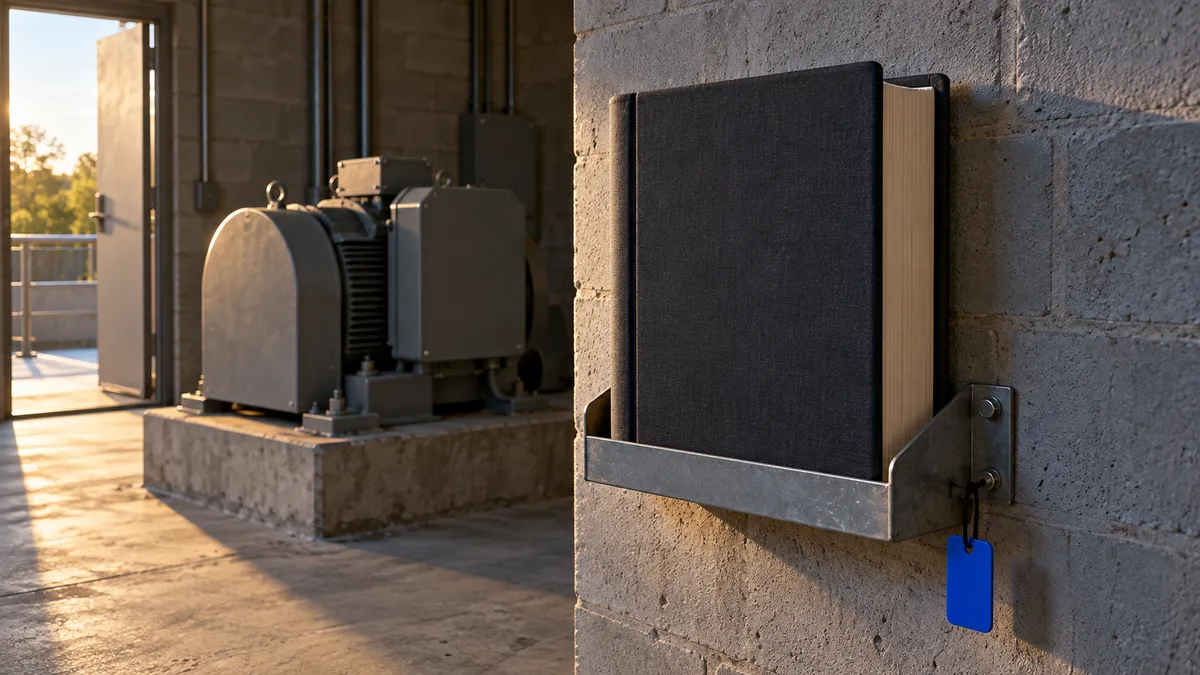
- A17.1 text: where the MCP is kept away from the machine room, the text (as quoted in Seattle’s code) allows posted instructions on the controller (or at the means necessary for test) that tell personnel how to locate or view it, in hard copy or electronic form, in permanently legible characters at least 3 mm high (UpCodes).
- Some jurisdictions amend it. Seattle’s building code removes that remote option and requires the MCP to be posted in the machine room, machinery space or control room. Nova Scotia’s directive requires all MCP documents and maintenance records to be kept on site in hard copy and says electronic documents are not acceptable there (Nova Scotia).
- Others restate the rule. Wisconsin says maintenance records shall be viewable on site by elevator personnel at all times from acceptance or installation, and that the contractor transfers records to the paper copy within 3 months (Wisconsin DSPS).
The practical rule: before you go paperless on a route, read the adopting code and any directives for each jurisdiction you work in. A tablet record that’s fine in one jurisdiction can be a write-up in the next.
Building an MCP for a unit, step by step
Here’s one way to rebuild a weak program. Adjust to your AHJ.
- Pull the unit facts. Equipment type (traction, hydraulic, MRL), controller make and model, install or last alteration date, and the AHJ unit number. The interval reasoning depends on these.
- List every code task that applies. Work through the maintenance section for that equipment type and list each examination, test and task with its requirement reference. Skip the ones that don’t apply and say why (a direct-acting hydraulic car typically has no governor, for example, so note that on the sheet instead of silently dropping the task).
- Set the interval and write the reason. Use manufacturer guidance as the starting point and adjust for usage and condition. A hospital car with heavy traffic and a two-stop freight car in a warehouse shouldn’t share a sheet.
- Attach or point to the procedures. Checkout procedures, unique manufacturer procedures and the wiring diagrams. If something is stored elsewhere, post the locating instructions in the format your AHJ accepts.
- Build the record sheet from the task list. One line per task per visit with date, interval, requirement and completion. If the record can’t be tied back to a line in the MCP, the inspector can’t tie it back either.
- Add the test records. Category tests produce their own tags and reports. Keep them with the unit’s maintenance records. Our Category 5 test procedure and Cat 1 test checklist cover what to capture on test day.
- Set the review trigger. Revisit the program when the code edition changes, after an alteration, after a callback pattern on a component, and at least on a schedule you write into the MCP itself.
Keeping it current across a route
One unit is easy. A route of 300 is where MCPs drift.
Tie every visit to the task list. If the technician’s visit form is a free-text note, the record will never match the program. The form should list the tasks due on that visit, pulled from the unit’s MCP, so the tech marks completion line by line.
Watch the task intervals as well as the visits. A unit can get a monthly visit and still miss a quarterly task three times in a row. Track due dates per task.
Handle contractor changes on day one. When you take over a building, the previous contractor’s MCP may not reflect your procedures. The maintaining firm provides the MCP, so plan to write or adopt your own program for each unit at takeover, and keep the previous contractor’s records with the unit.
Illustrative example (made-up numbers, for the arithmetic only): a route of 240 units, each with 18 MCP task lines on average, is 4,320 task lines to track. If 5 percent are overdue at audit time, that’s 216 lines an inspector could cite. Overdue lines that spread across 240 machine rooms are hard to spot in paper binders.
Where software helps, and where it doesn’t
Software can hold the per-unit task list, generate each visit’s checklist from it, track due dates per task and keep the completion record with date and technician. It can also keep photos and notes with the unit record. It can’t decide your intervals for you, and it doesn’t change your AHJ’s rule on hard copy. In a jurisdiction that requires paper on site, you still print and post.
Forz’s elevator service software is built around per-unit assets, recurring task schedules and inspection records, so the MCP task list and the visit form come from the same place. Inspections and asset tracking covers the per-unit history. Forz is $50 per user per month on annual billing or $60 month-to-month, with a 10-user minimum. See pricing.
For a comparison of the platforms elevator contractors shortlist, see our elevator contractor software roundup.
Frequently asked questions
What should a technician’s visit form pull from the MCP?
The tasks due on that visit, each with its interval and the code requirement it maps to, so completion is marked line by line.
Can the MCP be electronic?
Sometimes. The A17.1 wording lets an MCP kept away from the machine room be located or viewed in hard copy or electronic form if locating instructions are posted. The wiring diagrams and procedures kept beside it are written as hard copy in the text we reviewed, and jurisdictions amend both. Seattle requires the MCP posted in the machine room, Nova Scotia requires hard copy on site, and Wisconsin requires records transferred to the paper copy within 3 months. Read your adopting code and directives before going paperless.
Does the MCP change when the code edition changes?
The A17.1 wording says the MCP shall be updated where maintenance tasks, procedures, examinations or tests have been revised in Section 8.6. In practice, review each program when your AHJ adopts a new edition.
Are test records part of the MCP?
Test tags and reports are kept with the unit’s maintenance records and referenced by the program. The tests themselves are covered on our ASME A17.1 testing categories post.
Sources
- UpCodes, Seattle Building Code 2018, Section 3029 (A17.1/CSA B44 8.6.1 as amended), “Requirements for Maintenance Control Program and Remote Monitoring” (fetched 2026-10-29)
- Nova Scotia, Safety Directive 00012, Maintenance Control Program, Maintenance Records and Witnessing of Tests (issued March 9, 2026)
- Wisconsin DSPS, Maintenance Record Requirements
- ASME A17.1/CSA B44 (purchase from ASME; code text not reproduced here)